The eBooks we sell are sold as a single-user licence and are intended for the end user only.
The sale of some eBooks are restricted to certain countries. To alert you to such restrictions, please select the country of the billing address of your credit or debit card you wish to use for payment.
For further information see https://www.wildy.com/ebook-formats
Once the order is confirmed an e-mail will be sent to you to allow you to download the eBook. For UK purchases this will be automatic. For purchases outside the UK a member of staff will need to confirm the sale. (Staff are available to do this during normal business hours, Mon-Fri 8:30-17:00 UK time)
All eBooks are supplied firm sale and cannot be returned. If you believe there is a fault with your eBook then contact us on ebooks@wildy.com and we will help in resolving the issue. This does not affect your statutory rights.
Due to a technical issue some ebooks are not available to order.
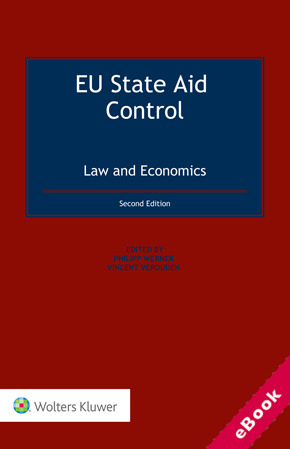
This second edition of EU State Aid Control: Law and Economics is an in-depth analysis of the legal and economic principles of EU State aid control, thoroughly exploring the central rationales of State aid and the various trade-offs that underlie the rules and decisions taken by the Commission and the Courts. When the first edition was published eight years ago, it was a first-of-its-kind book.
Since the first edition the world has seen a great deal of developments that seemed to be a thing of the past: Brexit, the COVID-19 pandemic, and Russia’s invasion of Ukraine. European politics and the law of the European Union have had to adapt to these challenges and changes, and EU State aid law has been no exception. In recent years, the European Commission has reviewed and adapted the General Block Exemption Regulation (GBER), as well as its Guidelines and communications covering practically all areas of State aid control. New rules have also sprouted, such as the EU/UK Trade and Cooperation Agreement, a new set of crisis rules in the wake of the COVID-19 pandemic, the Foreign Subsidies Regulation, and the Temporary Crisis and Transition Framework, which are all profoundly influencing, expanding, and modifying State aid control law and practice in the EU. Concurrently, the European Courts have shaped State aid law through several significant judgments.
The second edition of this book reflects these developments and their legal and economic implications. It has been thoroughly revised, updated and expanded. New chapters include:As a critical assessment of the current status of EU State aid control from both legal and economic perspectives and as an authoritative guide through its complexities and pitfalls, this book will be highly appreciated, now and in the years to come, by all stakeholders required to understand, interpret and apply EU State aid rules.