
The eBooks we sell are sold as a single-user licence and are intended for the end user only.
The sale of some eBooks are restricted to certain countries. To alert you to such restrictions, please select the country of the billing address of your credit or debit card you wish to use for payment.
For further information see https://www.wildy.com/ebook-formats
Once the order is confirmed an e-mail will be sent to you to allow you to download the eBook. For UK purchases this will be automatic. For purchases outside the UK a member of staff will need to confirm the sale. (Staff are available to do this during normal business hours, Mon-Fri 8:30-17:00 UK time)
All eBooks are supplied firm sale and cannot be returned. If you believe there is a fault with your eBook then contact us on ebooks@wildy.com and we will help in resolving the issue. This does not affect your statutory rights.
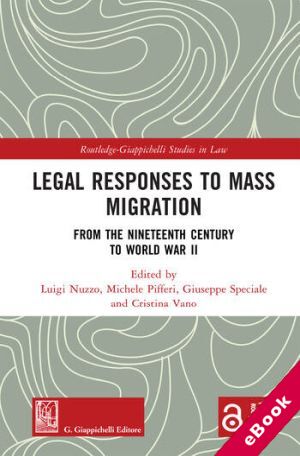
This volume explores the legal history of migration and the role played by legal theories, case law, practices, customary laws, and legislations in shaping and governing mobility between the 19th century and the Second World War. Based on different methodological approaches and sources, including archival documents, special courts’ decisions, diplomatic materials, legal journals and books, and international treaties, the chapters focus on countries of departure and destination both in Western and Eastern regions. Confronted with mass migration, Western legal science has been forced to rethink concepts and institutions such as borders, citizenship and the principle of territoriality. Special courts and administrative bodies were created to govern and control this new complex social phenomenon. This work, related to the national research project Legal History and Mass Migration: Integration, Exclusion, and Criminalization of Migrants in the 19th and 20th Century (Prin 2017), contributes to the investigation of the historical tensions between individual freedom of mobility and state sovereignty over border control. It contributes to the current public debate on ius migrandi – freedom of movement, or the right to migrate – showing the complexity of its historical dimension.
The book will be of interest to scholars in the fields of Legal History, Legal Theory, Sociology of Law, International Migration Law, Labor Law and Criminology, as well as those working on themes related to Forced Migration and Refugee Studies.
Chapter 16 of this book is available for free in PDF format as Open Access from the individual product page at www.taylorfrancis.com. It has been made available under a Creative Commons Attribution-Non Commercial-No Derivatives 4.0 license.










