The eBooks we sell are sold as a single-user licence and are intended for the end user only.
The sale of some eBooks are restricted to certain countries. To alert you to such restrictions, please select the country of the billing address of your credit or debit card you wish to use for payment.
For further information see https://www.wildy.com/ebook-formats
Once the order is confirmed an e-mail will be sent to you to allow you to download the eBook. For UK purchases this will be automatic. For purchases outside the UK a member of staff will need to confirm the sale. (Staff are available to do this during normal business hours, Mon-Fri 8:30-17:00 UK time)
All eBooks are supplied firm sale and cannot be returned. If you believe there is a fault with your eBook then contact us on ebooks@wildy.com and we will help in resolving the issue. This does not affect your statutory rights.
Due to a technical issue some ebooks are not available to order.
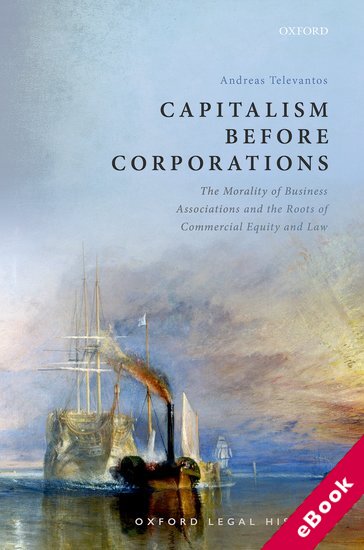
To what extent did English law facilitate trade before the advent of general incorporation and modern securities law? This is the question at the heart of Capitalism before Corporations. It examines the extent to which legal institutions of the Regency period, especially Lord Eldon's Chancellorship, were sympathetic to the needs of merchants and willing to accommodate their changing practices and demands within established legal doctrinal frameworks and contemporary political economic thought. In so doing, this book probes at the heart of modern debates about equity, trusts, insolvency, and the justifiability of corporate privileges.
Corporations are an integral part of modern life. We bank with corporations, we usually buy our groceries from them, and they provide us with most news and media. We take it for granted too that most large-scale business, and even much small-scale business, is carried out by corporations. Things were not always so. Televantos considers the Bubble Act of 1720, which criminalised the forming of corporations without a Royal Charter or Act of Parliament, its repeal in 1825, and the subsequent impact. Much of the modernisation of Britain's industry therefore took place before general incorporation was allowed. Unaided by statute, traders had to create business organisations using the basic building blocks of private law: trusts, partnership, and agency.
Key Features: