The eBooks we sell are sold as a single-user licence and are intended for the end user only.
The sale of some eBooks are restricted to certain countries. To alert you to such restrictions, please select the country of the billing address of your credit or debit card you wish to use for payment.
For further information see https://www.wildy.com/ebook-formats
Once the order is confirmed an e-mail will be sent to you to allow you to download the eBook. For UK purchases this will be automatic. For purchases outside the UK a member of staff will need to confirm the sale. (Staff are available to do this during normal business hours, Mon-Fri 8:30-17:00 UK time)
All eBooks are supplied firm sale and cannot be returned. If you believe there is a fault with your eBook then contact us on ebooks@wildy.com and we will help in resolving the issue. This does not affect your statutory rights.
Due to a technical issue some ebooks are not available to order.
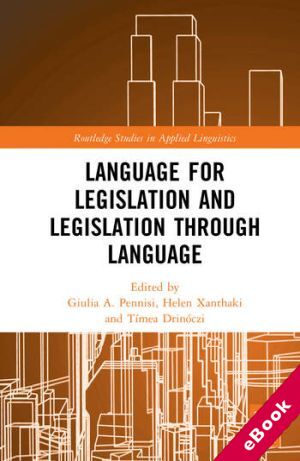
This collection teaches us how language and legislation interact to produce effective laws. It brings linguistics, lawyers, theory, and practices together to show how linguistic tools, concepts, and methodologies can be applied to improve the law's clarity, transparency, and efficiency, thus widening its social reach.
Drawing on case studies across Europe, chapters critically reflect on the dynamics of legislative drafting and the dissemination of legislation and the ways in which drafted legislation both creates laws and serve to communicate their meaning. The book features perspectives from national and transnational examples to demonstrate the impact of varied stakeholders—legislative bodies, law interpreters, and law enforcers – on the implementation of legislation, particularly when legislative texts are translated and interpreted across different settings. Through the lens of discourse analysis, legislative texts are analyzed in lexico-grammatical and textual terms, highlighting the disparity between what is conceived and what might be expressed clearly in words and how this knowledge can inform better drafting practices. The book charts a way forward for linguistics as a discipline to contribute to a better understanding of the nuances around effective legislative expression.
This book will appeal to scholars and stakeholders working at the intersection of language and the law, in such fields as applied linguistics, forensic linguistics, regulation, legislation, and legislative drafting.