The eBooks we sell are sold as a single-user licence and are intended for the end user only.
The sale of some eBooks are restricted to certain countries. To alert you to such restrictions, please select the country of the billing address of your credit or debit card you wish to use for payment.
For further information see https://www.wildy.com/ebook-formats
Once the order is confirmed an e-mail will be sent to you to allow you to download the eBook. For UK purchases this will be automatic. For purchases outside the UK a member of staff will need to confirm the sale. (Staff are available to do this during normal business hours, Mon-Fri 8:30-17:00 UK time)
All eBooks are supplied firm sale and cannot be returned. If you believe there is a fault with your eBook then contact us on ebooks@wildy.com and we will help in resolving the issue. This does not affect your statutory rights.
Due to a technical issue some ebooks are not available to order.
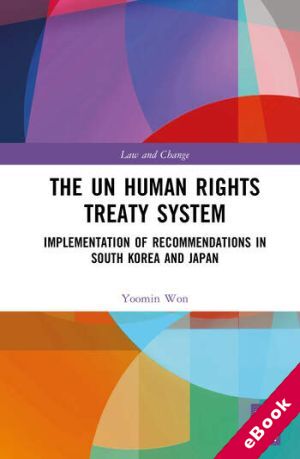
Through a use of both qualitative and quantitative methodologies, Won provides a nuanced analysis and discussion of the factors and domestic processes influencing the implementation of United Nations Human Rights Committee (UNHRC) recommendations in South Korea and Japan, as well as across the globe.
Won’s research entangles the theoretical debate on whether the UN human rights treaty system is effective in prompting the implementation of HRC recommendations. Her findings, based on interviews with activists, lawyers, scholars, judges, and other practitioners in Korea and Japan, point to the complex interplay of treaty bodies, state parties, and civil society organizations in human rights implementation. In addition, Won creates a novel empirical dataset to assess the key variables associated with improvement in human rights action across 103 countries. The findings suggest that human rights treaties matter not only to countries with high levels of democracy, but authoritarian regimes.
A unique empirical analysis of international human rights action as driven by UN recommendations, this book will be of interest to scholars and students of international law, human rights, and international relations, as well as human rights lawyers and the NGO Human Rights Communities.