The eBooks we sell are sold as a single-user licence and are intended for the end user only.
The sale of some eBooks are restricted to certain countries. To alert you to such restrictions, please select the country of the billing address of your credit or debit card you wish to use for payment.
For further information see https://www.wildy.com/ebook-formats
Once the order is confirmed an e-mail will be sent to you to allow you to download the eBook. For UK purchases this will be automatic. For purchases outside the UK a member of staff will need to confirm the sale. (Staff are available to do this during normal business hours, Mon-Fri 8:30-17:00 UK time)
All eBooks are supplied firm sale and cannot be returned. If you believe there is a fault with your eBook then contact us on ebooks@wildy.com and we will help in resolving the issue. This does not affect your statutory rights.
Due to a technical issue some ebooks are not available to order.
In the United States, federal judges occupy weighty positions. They interpret the Constitution, define people's rights and liberties, and apply laws and regulations to myriad cases. They also are older than ever. In 2023, the median age of a federal judge reached 70 for the first time. Nearly one-third of federal judges exceeded the age of 75. And ten percent were 85 years or older. The federal judiciary has become a graying judiciary.
Recent advances in neuroscience show that cognitive aging leads to processing speed delays, a decline in executive functioning skills like reasoning and memory, and a greater reliance on cognitive shortcuts. Judges are not immune from these effects. Simply put, cognitive aging influences all people. Judges are people. And so cognitive aging must influence them.
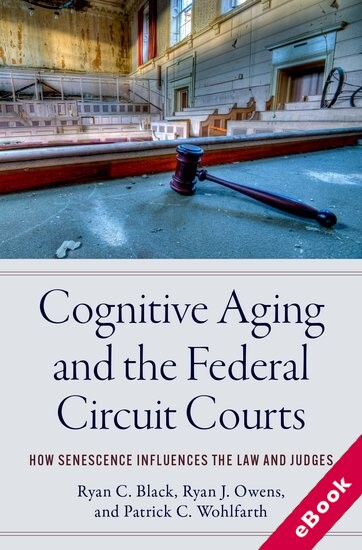
In Cognitive Aging and the Federal Circuit Courts: How Senescence Influences the Law and Judges, a distinguished team of authors investigates how cognitive aging influences federal circuit court judges. The first-of-their-kind results show that as judges age, they require more time to craft their opinions; they rely more on cognitive shortcuts; their opinions become less complex; they increasingly rely on others to help them write opinions; and their legal influence on panels wanes just as their susceptibility to persuasion increases. These results are sure to transform broad debates about institutional reform.