The eBooks we sell are sold as a single-user licence and are intended for the end user only.
The sale of some eBooks are restricted to certain countries. To alert you to such restrictions, please select the country of the billing address of your credit or debit card you wish to use for payment.
For further information see https://www.wildy.com/ebook-formats
Once the order is confirmed an e-mail will be sent to you to allow you to download the eBook. For UK purchases this will be automatic. For purchases outside the UK a member of staff will need to confirm the sale. (Staff are available to do this during normal business hours, Mon-Fri 8:30-17:00 UK time)
All eBooks are supplied firm sale and cannot be returned. If you believe there is a fault with your eBook then contact us on ebooks@wildy.com and we will help in resolving the issue. This does not affect your statutory rights.
Due to a technical issue some ebooks are not available to order.
National security decisions pose a paradox: they are among the most consequential a government can make, but are generally the least transparent to the democratic public. The "black box" nature of national security decision-making —driven by extensive classification and characterized by difficulty overseeing executive actions—has expanded in the United States as executive power continues to grow.
The rise of artificial intelligence (AI) systems to enhance national security decision-making—or even to make autonomous decisions—deepens this challenge, because it is difficult to understand how AI algorithms, often described as "black boxes," reach their conclusions. The widespread use of AI inside the national security ecosystem renders U.S. national security choices even more opaque to the public, congressional overseers, U.S. allies, and even the executive officials making the decisions. How can we be confident that the U.S. governments use of these AI systems comports with our values, including rationality, lawfulness, and accountability?
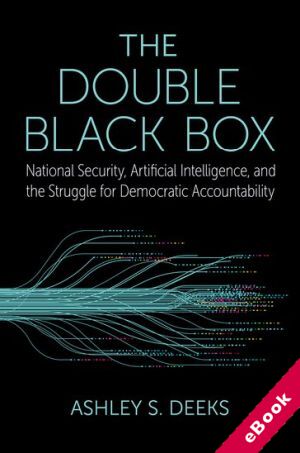
The Double Black Box: National Security, Artificial Intelligence, and the Struggle for Democratic Accountability addresses these pressing challenges. Because China is committed to becoming the world leader in AI and faces fewer legal and values-based constraints on its pursuit of military AI, democracies' commitment to using AI in lawful and ethical ways will be tested. This book defines and explores the "double black box" phenomenon and then identifies ways that policymakers, military and intelligence officials, and lawyers in democratic states such as the United States can reap the advantages of advanced technologies without surrendering their public law values.