The eBooks we sell are sold as a single-user licence and are intended for the end user only.
The sale of some eBooks are restricted to certain countries. To alert you to such restrictions, please select the country of the billing address of your credit or debit card you wish to use for payment.
For further information see https://www.wildy.com/ebook-formats
Once the order is confirmed an e-mail will be sent to you to allow you to download the eBook. For UK purchases this will be automatic. For purchases outside the UK a member of staff will need to confirm the sale. (Staff are available to do this during normal business hours, Mon-Fri 8:30-17:00 UK time)
All eBooks are supplied firm sale and cannot be returned. If you believe there is a fault with your eBook then contact us on ebooks@wildy.com and we will help in resolving the issue. This does not affect your statutory rights.
Due to a technical issue some ebooks are not available to order.
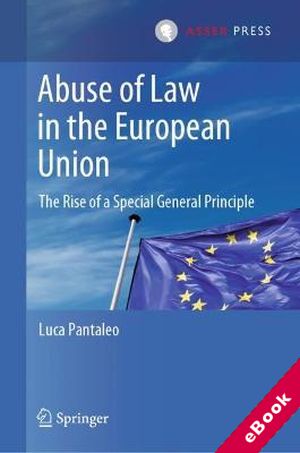
This book centres on the principle of abuse of law in the EU legal order. It deals with this subject from both a practical and theoretical perspective, as it provides a thorough assessment of the relevant case law of the Court of Justice as well as an in-depth analysis of the theoretical foundations of this principle.
The monograph looks to provide a general, comprehensive examination of the topic in order to systematise it in a coherent framework. By doing so, it intends to fill a gap in the current literature.
The book argues that abuse of Union law is a general principle of EU law with special features, which carries out two main functions: on the one hand, it ensures that EU rights are exercised in a manner that is consistent with the purpose for which they have been granted; on the other hand, it has a second and more fundamental function. For it is aimed at guaranteeing the systemic coherence of the system, ultimately serving the universal notions of justice and fairness, contributing to the further development and progress of EU law over time.
The monograph should prove beneficial primarily to those who conduct fundamental research in EU law but also to practitioners, given that the practical applications of this principle have significantly increased in recent years.