We will be closed from 5pm BST on Friday 28th August 2026 for the late summer bank holiday, re-opening at 8.30am BST on Tuesday 1st September. Any orders placed during this period will be processed when we re-open.
The eBooks we sell are sold as a single-user licence and are intended for the end user only.
The sale of some eBooks are restricted to certain countries. To alert you to such restrictions, please select the country of the billing address of your credit or debit card you wish to use for payment.
For further information see https://www.wildy.com/ebook-formats
Once the order is confirmed an e-mail will be sent to you to allow you to download the eBook. For UK purchases this will be automatic. For purchases outside the UK a member of staff will need to confirm the sale. (Staff are available to do this during normal business hours, Mon-Fri 8:30-17:00 UK time)
All eBooks are supplied firm sale and cannot be returned. If you believe there is a fault with your eBook then contact us on ebooks@wildy.com and we will help in resolving the issue. This does not affect your statutory rights.
Due to a technical issue some ebooks are not available to order.
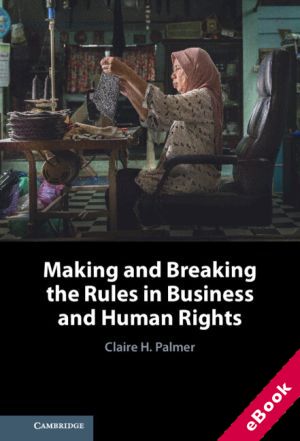
How do we make corporations accountable for human rights violations? This book illuminates how governments, international organisations, NGOs and individuals make (and break) the rules in business and human rights.
It covers a rich array of examples of rule-making in business and human rights, including: (i) legal developments in domestic courts in the US, Canada, the UK, and Europe; (ii) initiatives endorsed by the United Nations, including the 2011 UN Guiding Principles; and (iii) multistakeholder initiatives such as the Kimberley Process Certification Scheme (KPCS), the Extractive Industries Transparency Initiative (EITI), and the Voluntary Principles on Security and Human Rights (VPs). It also introduces a new theoretical framework to assist scholars in understanding trends in the area of business and human rights. By emphasising implementation, the framework brings much-needed conceptual clarity to the processes of rule-making and legalization and constitutes an important contribution to the business and human rights literature.