The eBooks we sell are sold as a single-user licence and are intended for the end user only.
The sale of some eBooks are restricted to certain countries. To alert you to such restrictions, please select the country of the billing address of your credit or debit card you wish to use for payment.
For further information see https://www.wildy.com/ebook-formats
Once the order is confirmed an e-mail will be sent to you to allow you to download the eBook. For UK purchases this will be automatic. For purchases outside the UK a member of staff will need to confirm the sale. (Staff are available to do this during normal business hours, Mon-Fri 8:30-17:00 UK time)
All eBooks are supplied firm sale and cannot be returned. If you believe there is a fault with your eBook then contact us on ebooks@wildy.com and we will help in resolving the issue. This does not affect your statutory rights.
Due to a technical issue some ebooks are not available to order.
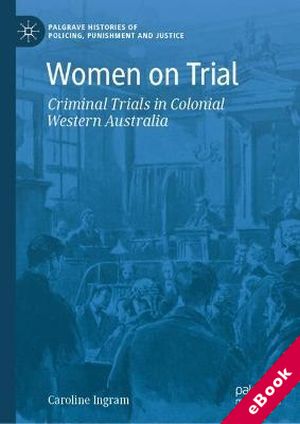
This book considers how legal rules and institutions affected the outcome of women's trials in nineteenth century Western Australia and how this was mediated by various social and cultural constructs. It uses numerous case studies to determine the effect of legal representation, co-accused status, Aboriginality and mercy on the outcome of these women's trials. The stories of these mainly working-class women, often traced through trials records and witness depositions, also illuminates the challenges and pitfalls of their lives, the survival strategies they used to navigate these and the pathways that led them to be charged with serious crime. Western Australia offers a different set of conditions for examining female criminality. Its small population meant that women committing crime often became well-known identities within their communities and may have been known, at least by reputation, to the limited number of men eligible for jury duty. Western Australia's low population meant that the number of lawyers practising in the colony was small and that few judges were appointed. During this period Western Australia also created separate laws to apply only to Aboriginal defendants meaning that Aboriginal women became subject to different laws to non-Aboriginal women.
The book examines how, and why, some women appeared to receive a more lenient outcome, whereas others were less fortunate. Despite the all-male nature of the criminal justice system in which they appeared, some women appeared to possess a degree of legal literacy which allowed them to use the system to achieve a more favourable outcome in court. This book will be of interest to scholars of criminology, as well as those interested in the history of crime, Western Australian history and the history of the criminal justice system in Australia.