
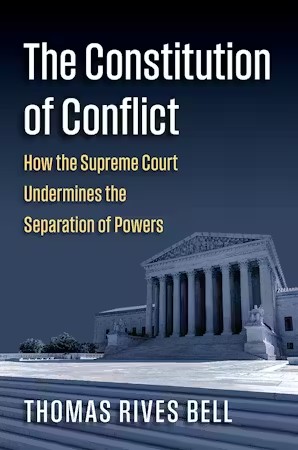
A bold and timely proposal for rethinking the role of the Supreme Court in the separation of powers.
There is a widespread sense today that the separation of powers system is broken or dysfunctional and has become an obstacle to effective government. The Constitution of Conflict demonstrates that much of the problem comes from attempts to find legal answers to political problems. Challenging long-held assumptions about the Constitution, Thomas Rives Bell boldly argues that a separation of powers doctrine enforceable by the court is inconsistent with the constitutional design. Rather than establishing a legal doctrine, the Constitution set into motion a dynamic political system that governs through conflict within and among differentiated institutional structures.
Bell shows that Congress and the president have previously found constitutional solutions to issues like the administrative state, only to be thwarted by the Supreme Court. He critiques the court’s different methodologies for resolving these disputes, demonstrating that, rhetoric aside, both originalist accounts and functionalist understandings seek primarily to enforce the separation of powers for its own sake rather than understanding the political system as the proper means by which to achieve the Constitution’s aspirations. Judicial superintendence of the separation of powers, moreover, places the court above rather than within the constitutional framework. Bell proposes that the court’s role in such disputes should be confined to government actions that directly implicate rights rather than to the policing of interbranch boundaries between Congress and the president.
Bell applies his proposed political framework to four case studies: the legislative veto, executive agreements, recess appointments, and congressional oversight and impeachment. These cases illuminate the logic and dynamic of the separation of powers, demonstrating that political conflict, rather than legal settlement, is an essential element of the constitutional design.










