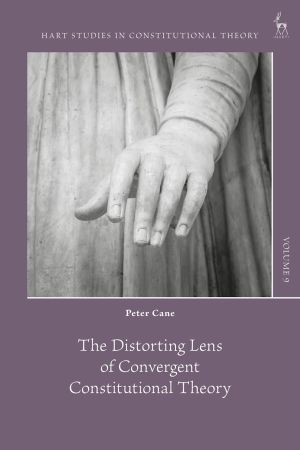
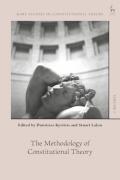
This book challenges the near-universal acceptance of a US-style, Western constitutional paradigm as the best basis for comparative constitutional studies. It does so on three main grounds: anachronism, 'othering' and cultural specificity.
Main pillars of 'convergent constitutional theory' are rooted in the revolutionary, late-eighteenth century – a lost world; constitutional arrangements that deviate from the paradigm are often branded as 'outliers' or even as not constitutional at all; and the foundations of the paradigm in liberal democracy give no space for other forms of constitutionalism. Whatever the attractions of convergent theory as a normative ideal of good government, for the purposes of understanding, analysing and explaining constitutional systems it is far from ideal.
This book discusses and questions: convergent theory's weddedness to writing as the technology of constitution-making; its image of a constitution as fundamental law; its idea that a constitution expresses the 'sovereignty of the people'; its use of tripartite separation of powers as the basic principle of institutional design; its relative neglect of administrative law; its association of 'rights' with judicially enforceable bills of rights; and its obsession with a vaguely specified concept of 'democracy'.
It makes suggestions for alternative, preferable methods of understanding, analysing and explaining constitutions, and governmental and constitutional systems.

Due to a technical issue some ebooks are not available to order.
Due to a technical issue some ebooks are not available to order.
Due to a technical issue some ebooks are not available to order.
Due to a technical issue some ebooks are not available to order.
Due to a technical issue some ebooks are not available to order.
Due to a technical issue some ebooks are not available to order.
Due to a technical issue some ebooks are not available to order.