The eBooks we sell are sold as a single-user licence and are intended for the end user only.
The sale of some eBooks are restricted to certain countries. To alert you to such restrictions, please select the country of the billing address of your credit or debit card you wish to use for payment.
For further information see https://www.wildy.com/ebook-formats
Once the order is confirmed an e-mail will be sent to you to allow you to download the eBook. For UK purchases this will be automatic. For purchases outside the UK a member of staff will need to confirm the sale. (Staff are available to do this during normal business hours, Mon-Fri 8:30-17:00 UK time)
All eBooks are supplied firm sale and cannot be returned. If you believe there is a fault with your eBook then contact us on ebooks@wildy.com and we will help in resolving the issue. This does not affect your statutory rights.
Due to a technical issue some ebooks are not available to order.
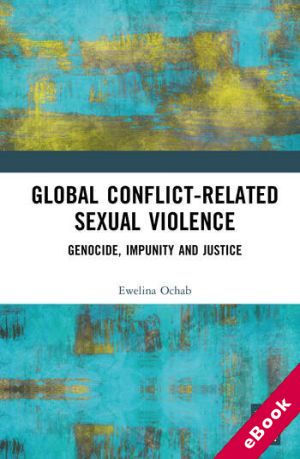
Sexual violence in conflict, often referred to as conflict-related sexual violence (CRSV), refers to some form of sexual and/or reproductive violence perpetrated against women, men, girls and boys that is directly or indirectly related to the conflict. This includes rape, sexual slavery, forced prostitution, forced pregnancy, forced abortion, enforced sterilisation, forced marriage, and any other form of sexual violence of comparable gravity. The perpetrators of CRSV vary between each case and include state and non-state armed groups, including terrorist organisations.
This book examines some of the recent manifestations of sexual violence as atrocity crimes, and especially, prohibited acts to bring about genocide, the responses to these crimes, and issues that continue to be neglected, including in relation to the duty to prevent. The work structures the discussion around the prevalence of CRSV, its use as a tool of genocide, and other international crimes, and the failures of legal and institutional responses. By combining thematic chapters on international law and accountability with case studies, the study provides a balance between theoretical critique and empirical analysis. It further engages with the debates on what is needed to bring about change, looking at specific policy and law reforms. The work also examines the way forward, including recommendations to introduce an international convention specifically focused on CRSV, and a permanent mechanism on CRSV.
The book will be of interest to academics, researchers and policy-makers working in the areas of International Criminal Law, International Humanitarian Law, Human Rights Law, Constitutional Law, Legal History, Security Studies and Genocide Studies.