
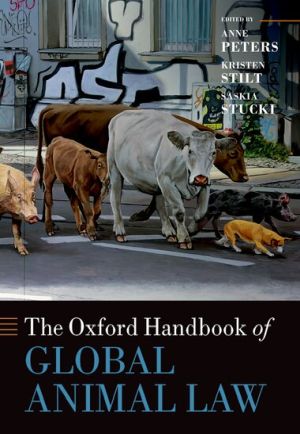
The Oxford Handbook of Global Animal Law establishes the field of global animal law (GAL). GAL engages with the legal status and legal protection of animals (both as individuals and species) in today's globalized world. GAL refers both to the fragmented body of law that is relevant to animals in a global context and to the production of scholarly literature that builds upon the recognition of this law to discern connections and causations, influences and deterrents. GAL as scholarship is responsive to the distinctive and interlinked problems the globalized world poses for animals and seeks to improve animal welfare, rights, and species conservation through a web of transnational, international, regional, domestic, local, customary, religious, and indigenous forms of normativity. Current human-animal relations, especially human dominance over, exploitation, and extermination of animals, are not only causing mass animal suffering, misery, and death on a global scale, but are also associated with ecological, social, and public health pressures that adversely affect humans and the entire planet. It is because of the global and interconnected nature of these issues that a global law approach is needed. The formation of a global animal law is notably warranted as a response to economic and cultural globalization, as a contribution to global sustainable development, and as an imperative of global justice.
This Handbook lays out GAL's multidisciplinary foundations; delineates key concepts, principles, and actors shaping the field; maps the contours and features of emerging global animal law across a range of existing legal regimes (such as environmental, food, health, and human rights law); identifies its various legal sources on the level of international, regional, and domestic law (facilitated through country reports from all over the world); deals with the implementation and enforcement of GAL, with attention to procedural aspects; and engages a variety of voices and perspectives to explore new horizons and envision, together, the future of a truly global animal law.











