The eBooks we sell are sold as a single-user licence and are intended for the end user only.
The sale of some eBooks are restricted to certain countries. To alert you to such restrictions, please select the country of the billing address of your credit or debit card you wish to use for payment.
For further information see https://www.wildy.com/ebook-formats
Once the order is confirmed an e-mail will be sent to you to allow you to download the eBook. For UK purchases this will be automatic. For purchases outside the UK a member of staff will need to confirm the sale. (Staff are available to do this during normal business hours, Mon-Fri 8:30-17:00 UK time)
All eBooks are supplied firm sale and cannot be returned. If you believe there is a fault with your eBook then contact us on ebooks@wildy.com and we will help in resolving the issue. This does not affect your statutory rights.
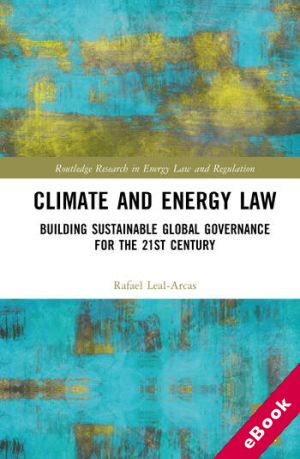
This book offers a bold and timely rethinking of how sustainable energy transitions can be achieved in an era of climate urgency and geopolitical uncertainty. Challenging the traditional top-down model of governance, the volume advances a compelling argument for a bottom-up transformation driven by citizens, prosumers, cities, and new market actors.
The book locates this shift within a broader structural transformation of the energy sector, namely from supply-driven systems to demand-side governance centered on electrification, renewable energy, efficiency, smart grids, and digital innovation. By integrating legal, economic, technological, and policy perspectives, it demonstrates how decentralization, democratization, digitalization, deregulation, and decarbonization are reshaping global energy governance. Combining theoretical analysis with practical EU-based case studies, the book explores smart grids, collaborative economics, decentralized energy markets, and the evolving role of prosumers in ensuring energy security and sustainability. It also addresses critical challenges, including cybersecurity, infrastructure finance, and regulatory design.
Bridging trade, energy, climate change, and sustainability, this work highlights a crucial knowledge gap and offers an innovative governance framework fit for the 21st century. Essential reading for scholars, policymakers, and practitioners in climate law, energy law, and global governance, the book provides a forward-looking blueprint for building a more inclusive, resilient, and sustainable global energy order.