The eBooks we sell are sold as a single-user licence and are intended for the end user only.
The sale of some eBooks are restricted to certain countries. To alert you to such restrictions, please select the country of the billing address of your credit or debit card you wish to use for payment.
For further information see https://www.wildy.com/ebook-formats
Once the order is confirmed an e-mail will be sent to you to allow you to download the eBook. For UK purchases this will be automatic. For purchases outside the UK a member of staff will need to confirm the sale. (Staff are available to do this during normal business hours, Mon-Fri 8:30-17:00 UK time)
All eBooks are supplied firm sale and cannot be returned. If you believe there is a fault with your eBook then contact us on ebooks@wildy.com and we will help in resolving the issue. This does not affect your statutory rights.
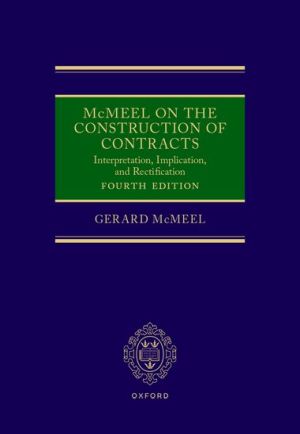
This fourth edition is an authority on the construction of contracts. It uniquely encompasses all the principal techniques by which the meaning and effect of agreements are ascertained: the interpretation of express language, the implication of terms, and the rectification of documents. The general principles of interpretation and the implication of terms implied in fact-or gap-fillers-have been relatively settled in the period since the last edition. Meanwhile terms implied in law, or general default rules, have come to the forefront in a sequence of Supreme Court judgments, including Wells v Devani, Triple Point Technology Inc v PTT, Barton v Morris, and Philipp v Barclays Bank, which have emphasized their role in providing transactional templates and setting minimum standards. Likewise, this edition explores the changes to the principles of common mistake rectification, analysing the impact of the Court of Appeal in FSHC Group Holdings v Glas Trust, and the Supreme Court in RMT v Nexus.
The fourth edition further explores how the contra proferentem principle has become unfashionable in the eyes of English judges, and has been superseded by the more muscular clear words principle, in respect of exemption clauses, force majeure, and more generally. Brand new chapters discuss restriction of variation ('no oral modification') clauses, in the wake of MWB v Rock Advertising, and dispute resolution agreements, after Enka v Chubb. The text addresses cases that emerged in the context of Brexit, the Covid-19 pandemic, and renewed international conflicts and the accompanying sanctions. McMeel on the Construction of Contracts continues to be an essential reference work for commercial and corporate lawyers, both litigators and those negotiating and drafting deals, as well as the judges who rule on cases pertaining to contracts.