The eBooks we sell are sold as a single-user licence and are intended for the end user only.
The sale of some eBooks are restricted to certain countries. To alert you to such restrictions, please select the country of the billing address of your credit or debit card you wish to use for payment.
For further information see https://www.wildy.com/ebook-formats
Once the order is confirmed an e-mail will be sent to you to allow you to download the eBook. For UK purchases this will be automatic. For purchases outside the UK a member of staff will need to confirm the sale. (Staff are available to do this during normal business hours, Mon-Fri 8:30-17:00 UK time)
All eBooks are supplied firm sale and cannot be returned. If you believe there is a fault with your eBook then contact us on ebooks@wildy.com and we will help in resolving the issue. This does not affect your statutory rights.
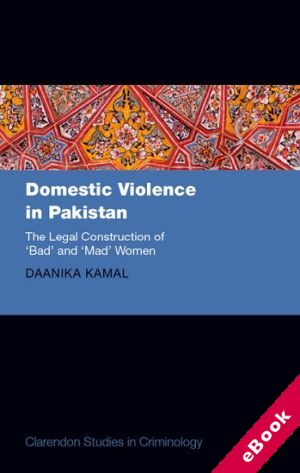
Pakistani women are increasingly pursuing legal avenues against acts of domestic violence. Their claims, however, are often dismissed through character allegations that label them as 'bad' women in need of control, or 'mad' women not to be trusted. Domestic Violence in Pakistan explores why the subjectivities of women victims are constructed in particular ways, and how these subjectivities are captured and negotiated in the Pakistani legal system.
Drawing on feminist poststructuralist accounts relating to the use of gendering strategies in institutional and disciplinary settings and based on an analysis of over a hundred case files and judgements, seventy-two interviews, and court observations in three cities of Pakistan, this book shadows the experiences of women victims of domestic violence in both criminal law and family law proceedings. It captures and offers empirical insights in relation to gendered subject formation in discursive spaces; ranging from the use of societal narratives that minimise and silence women's harms, to the deployment of police mechanisms that assist in maintaining the 'secrecy' of familial violence, and the application and enactment of boilerplate lawyerly strategies to present alternative legal 'truths.'
Amidst regulations of the public versus the private and understandings of rights versus duties, Domestic Violence in Pakistan explores how these practices construct the victim-subject of domestic violence in a way that not only subjectivise her, but also secure her within the field of that subjectification; setting her up to be viewed by the judiciary through the lens of the allegations applied to her.