The eBooks we sell are sold as a single-user licence and are intended for the end user only.
The sale of some eBooks are restricted to certain countries. To alert you to such restrictions, please select the country of the billing address of your credit or debit card you wish to use for payment.
For further information see https://www.wildy.com/ebook-formats
Once the order is confirmed an e-mail will be sent to you to allow you to download the eBook. For UK purchases this will be automatic. For purchases outside the UK a member of staff will need to confirm the sale. (Staff are available to do this during normal business hours, Mon-Fri 8:30-17:00 UK time)
All eBooks are supplied firm sale and cannot be returned. If you believe there is a fault with your eBook then contact us on ebooks@wildy.com and we will help in resolving the issue. This does not affect your statutory rights.
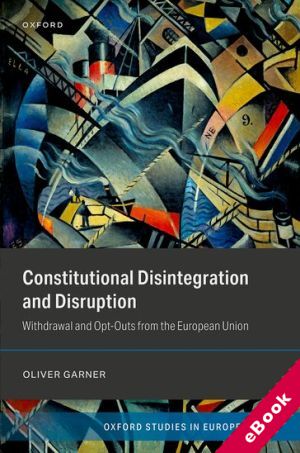
The United Kingdom's unprecedented withdrawal from the European Union in 2020 may be regarded as the first example of European 'disintegration'. This moment, however, was preceded by decades of 'disruption' as the UK, Ireland, and Denmark pursued opt-outs from the supranational constitutional order. Constitutional Disintegration and Disruption: Withdrawal and Opt-Outs from the European Union provides the first comprehensive analysis of these two constitutional phenomena.
The book presents the EU as an order that is legitimated by individuals playing a dual-role as both nationals of Member States and citizens of the Union; in turn, individuals are both democratic subjects and juridical objects. The EU Treaties have instituted a 'triptych' for the exercise of 'constituted constituent power' by these individuals: Article 49 TEU allowing accession, Article 48 TEU enabling amendment, and Article 50 TEU as a mechanism for the repatriation of power through withdrawal. Opt-outs are an iterative anomaly that have arisen through the retention of amendment power by representatives of Member State nationals. Reservations of constituent power have been operationalised in Protocols to the Treaties. By contrast, the withdrawal clause was proactively inserted into the Treaties as a sovereign right for Member State nationals subject to an orderly supranational procedure for the benefit of all EU citizens. The book presents narratives of disruption and disintegration that provide comprehensive historical overviews of how opt-outs and withdrawal arose and developed.
Constitutional Disintegration and Disruption concludes with criticism of the consequences of these phenomena for individuals, and proposes reforms to the EU Treaties that would enable citizens to more fully realise their dual-role in the European constitutional space.