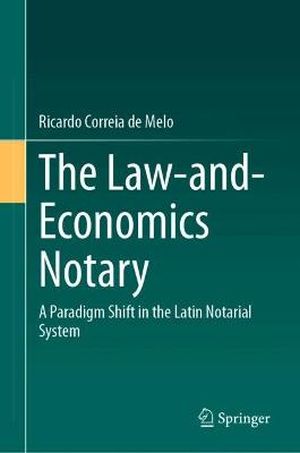
For centuries, the Latin notarial system has evolved in response to society's growing demand for legal certainty. Yet the increasing complexity of economic relations calls for a new stage in that evolution: a notarial system capable not only of ensuring legal certainty but also of realizing its full institutional potential to promote economic efficiency in private legal relationships through enhanced governance, conflict prevention, and the preservation of the contractual rationale built throughout the notarial process, so that disputes, when unavoidable, may be resolved consistently with the parties' legitimate choices, interests, and objectives.
This book argues that such evolution requires neither abandoning nor replacing the historical foundations of the Latin notariat, but reinterpreting them in light of contemporary economic challenges. It introduces the Law-and-Economics Notary as the central institutional figure of the Law-and-Economics Notarial Paradigm, a new theoretical framework explaining how the civil-law notarial system can meet growing demands for economic efficiency while preserving the principles that have historically defined its identity.
The book demonstrates that the Law-and-Economics Notary represents a new understanding of the notarial function. Public faith is conceived not only as an instrument of documentary authentication but also as a mechanism of private governance capable of structuring incentives, reducing transaction costs, mitigating information asymmetries and behavioral biases, strengthening trust among economic actors, and fostering more efficient, predictable, and socially beneficial legal relationships.
Developed independently through the integration of law, economics, and notarial practice, the Law-and-Economics Notarial Paradigm later proved to converge with the evolutionary direction reflected in the studies and institutional agenda of the International Union of Notaries. This independent convergence confirms its capacity to explain and operationalize institutional transformations already emerging across the modern civil-law notariat.
By integrating law, economics, and contractual governance, this book offers a new understanding of the notarial function and a coherent paradigm for the evolution of the Latin notarial system. Rather than replacing its traditional foundations, it demonstrates how they can be reinterpreted and further developed, thereby contributing to legal certainty, economic efficiency, preventive justice, and, ultimately, to economic development.