The eBooks we sell are sold as a single-user licence and are intended for the end user only.
The sale of some eBooks are restricted to certain countries. To alert you to such restrictions, please select the country of the billing address of your credit or debit card you wish to use for payment.
For further information see https://www.wildy.com/ebook-formats
Once the order is confirmed an e-mail will be sent to you to allow you to download the eBook. For UK purchases this will be automatic. For purchases outside the UK a member of staff will need to confirm the sale. (Staff are available to do this during normal business hours, Mon-Fri 8:30-17:00 UK time)
All eBooks are supplied firm sale and cannot be returned. If you believe there is a fault with your eBook then contact us on ebooks@wildy.com and we will help in resolving the issue. This does not affect your statutory rights.
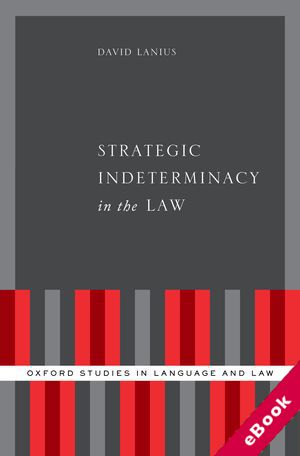
Though indeterminacy in legal texts is pervasive, there is a widespread misunderstanding about what indeterminacy is, particularly as it pertains to law.
Legal texts present unique challenges insofar as they address a heterogeneous audience, are applied in a variety of unforeseeable circumstances and must, at the same time, lay down clear and unambiguous standards. Sometimes they fail to do so, however, either by accident or by intention.
While many have claimed that indeterminacy facilitates flexibility and can be strategically used, few have recognized that there are more forms of indeterminacy than vagueness and ambiguity. A comprehensive account of legal indeterminacy is thus called for.
David Lanius here answers that call and in so doing, addresses three central questions about the role of indeterminacy in the law. First, what are the sources of indeterminacy in law? Second, what effects do the different forms of indeterminacy have? Third, how can and should these forms be intentionally used? Based on a thorough examination of the advantages and disadvantages of the different forms of indeterminacy in the wording of laws, contracts, and verdicts, Lanius argues for the claim that semantic vagueness is less relevant than commonly supposed in the debate, while other forms of indeterminacy (in particular, polysemy and standard-relativity) are mistakenly underrated or even ignored.
This misconception is due to a systematic confusion between semantic vagueness and these other forms of indeterminacy. Once it is resolved, the value and functions of linguistic indeterminacy in the law can be clearly shown.