The eBooks we sell are sold as a single-user licence and are intended for the end user only.
The sale of some eBooks are restricted to certain countries. To alert you to such restrictions, please select the country of the billing address of your credit or debit card you wish to use for payment.
For further information see https://www.wildy.com/ebook-formats
Once the order is confirmed an e-mail will be sent to you to allow you to download the eBook. For UK purchases this will be automatic. For purchases outside the UK a member of staff will need to confirm the sale. (Staff are available to do this during normal business hours, Mon-Fri 8:30-17:00 UK time)
All eBooks are supplied firm sale and cannot be returned. If you believe there is a fault with your eBook then contact us on ebooks@wildy.com and we will help in resolving the issue. This does not affect your statutory rights.
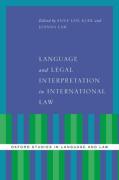
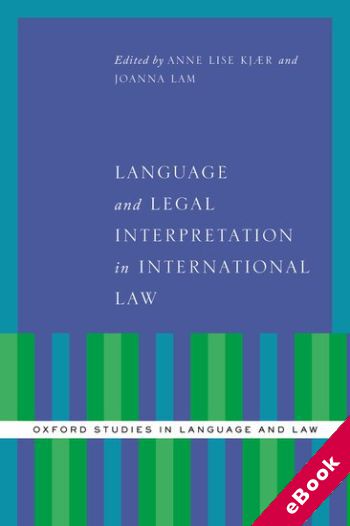
International law is usually communicated in more than one language and reflects common norms that lawyers and adjudicators across national legal cultures agree on and develop together. As a result, the negotiation of the wording and meaning of international legislative texts is an integral part of legal interpretation in international law. This book sheds light on that essential interpretation process.
Language and Legal Interpretation in International Law treats the subject from the perspective of recent legal and linguistic theories of meaning. Anne Lise Kjær and Joanna Lam bring together internationally renowned experts to provide strong theoretical and practical foundations for the study of legal interpretation in such fields as human rights law, international trade, investment and commercial law, EU law, and international criminal law. The volume explains how the positivist tradition—in which interpretation is understood as an automatic process by which judges simply apply the text of legislative instruments to specific fact situations—cannot be upheld in an era of pragmatic and cognitive meaning theories. Those theories instead focus on the context of interpretation and on the interpreter as a co-producer of meaning. Through a collection of thoroughly researched and timely essays, this book explores the linguistically and culturally diversified world of meaning-making in international law.