
The eBooks we sell are sold as a single-user licence and are intended for the end user only.
The sale of some eBooks are restricted to certain countries. To alert you to such restrictions, please select the country of the billing address of your credit or debit card you wish to use for payment.
For further information see https://www.wildy.com/ebook-formats
Once the order is confirmed an e-mail will be sent to you to allow you to download the eBook. For UK purchases this will be automatic. For purchases outside the UK a member of staff will need to confirm the sale. (Staff are available to do this during normal business hours, Mon-Fri 8:30-17:00 UK time)
All eBooks are supplied firm sale and cannot be returned. If you believe there is a fault with your eBook then contact us on ebooks@wildy.com and we will help in resolving the issue. This does not affect your statutory rights.
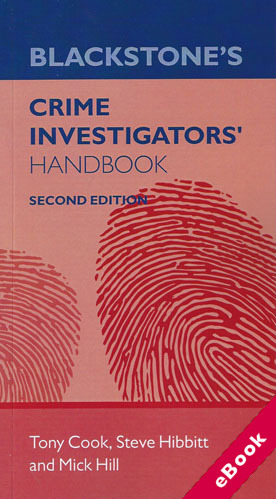
Blackstone's Crime Investigators' Handbook provides you with straightforward, practical information and advice for anyone involved in investigating crime.
Covering all the practical skills required for the Initial Crime Investigators Development Programme (ICIDP) Phases 2 and 3, as well as all PIP Level 2 investigations, it will also be useful to detectives and uniformed officers investigating volume crime, as well those involved in the initial stages of major investigations.
Covering the different types of criminal investigation, with outlines of the legal procedures and operational protocols relating to specific offences, the second edition of the Handbook includes new content relating to Female Genital Mutilation (FGM) and Child Sexual Exploitation (CSE).
There is also coverage of updated Disclosure obligations under the Criminal Procedure and Investigations Act 1996 amendments, and a new chapter covering cyber crime and communications data offences. Each stage of conducting and managing an investigation is explored, with specific guidance on crime scene management, evidence preservation, and witness and suspect management, helping you to build and develop your capabilities.
The Handbook also outlines the role of partner agencies and includes specific chapters on forensic investigation and the investigation of sudden and unexpected deaths. Police doctrines and practical guidance manuals are extensively cross-referenced, while checklists, aide memoirs, and key point boxes help contextualise the complex and sometimes daunting procedures, methods, and responsibilities.











