
The eBooks we sell are sold as a single-user licence and are intended for the end user only.
The sale of some eBooks are restricted to certain countries. To alert you to such restrictions, please select the country of the billing address of your credit or debit card you wish to use for payment.
For further information see https://www.wildy.com/ebook-formats
Once the order is confirmed an e-mail will be sent to you to allow you to download the eBook. For UK purchases this will be automatic. For purchases outside the UK a member of staff will need to confirm the sale. (Staff are available to do this during normal business hours, Mon-Fri 8:30-17:00 UK time)
All eBooks are supplied firm sale and cannot be returned. If you believe there is a fault with your eBook then contact us on ebooks@wildy.com and we will help in resolving the issue. This does not affect your statutory rights.
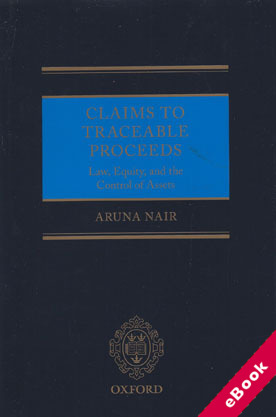
In this new book, Aruna Nair sets out her arguments for a re-evaluation of the law of tracing. A new model of the law of tracing is proposed and the book demonstrates how current problems can be solved using this new model.
The rules of tracing are not shown not to be pure rules of evidence, aimed at resolving factual uncertainties; rather, they are explained as substantive rules of law, delineating the scope of a defendant's legal responsibility to a claimant.
The book draws out the practical implications of this theoretical model, showing how a focus on defendant autonomy and claimant vulnerability can both explain the current state of English law and provide a critical perspective on potential future developments.
The first part of the book considers the nature of tracing, providing an overview of the analytical and doctrinal questions raised by the current law, re-framing the dominant 'value' account of tracing, and proposing a new model which can solve problems in the current law.
The second part of the book focusses on circumstances in which the tracing remedy is available to a claimant, demonstrating the practical application of such claims to specific problems.










