
The eBooks we sell are sold as a single-user licence and are intended for the end user only.
The sale of some eBooks are restricted to certain countries. To alert you to such restrictions, please select the country of the billing address of your credit or debit card you wish to use for payment.
For further information see https://www.wildy.com/ebook-formats
Once the order is confirmed an e-mail will be sent to you to allow you to download the eBook. For UK purchases this will be automatic. For purchases outside the UK a member of staff will need to confirm the sale. (Staff are available to do this during normal business hours, Mon-Fri 8:30-17:00 UK time)
All eBooks are supplied firm sale and cannot be returned. If you believe there is a fault with your eBook then contact us on ebooks@wildy.com and we will help in resolving the issue. This does not affect your statutory rights.
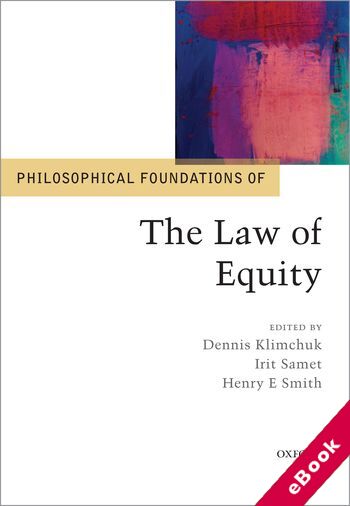
The law of Equity, a latecomer to the field of private law theory, raises fundamental questions about the relationships between law and morality, the nature of rights, and the extent to which we are willing to compromise on the rule of law ideal to achieve social goals. In this volume, leading scholars come together to address these and other questions about underlying principles of Equity and its relationship to the common law: What relationships, if any, are there between the legal, philosophical, and moral senses of 'equity'? Does Equity form a second-order constraint on law? If so, is its operation at odds with the rule of law? Do the various theories of Equity require some kind of separation of law and equity-and, if they do, what kind of separation? The volume further sheds light on some of the most topical questions of jurisprudence that are embedded in the debate around 'fusion'.
A noteworthy addition to the Philosophical Foundations series, this volume is an important contribution to an ongoing debate, and will be of value to students and scholars across the discipline.











