
The eBooks we sell are sold as a single-user licence and are intended for the end user only.
The sale of some eBooks are restricted to certain countries. To alert you to such restrictions, please select the country of the billing address of your credit or debit card you wish to use for payment.
For further information see https://www.wildy.com/ebook-formats
Once the order is confirmed an e-mail will be sent to you to allow you to download the eBook. For UK purchases this will be automatic. For purchases outside the UK a member of staff will need to confirm the sale. (Staff are available to do this during normal business hours, Mon-Fri 8:30-17:00 UK time)
All eBooks are supplied firm sale and cannot be returned. If you believe there is a fault with your eBook then contact us on ebooks@wildy.com and we will help in resolving the issue. This does not affect your statutory rights.
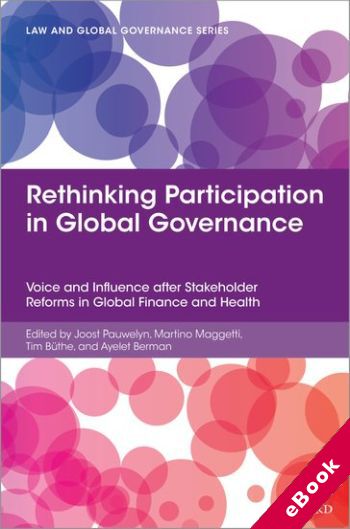
International organizations and other global governance bodies often make rules and decisions without input from many of the individuals, groups, firms, and governments that are affected by them. The standards of the Basel Committee on Banking Supervision, for instance, developed by a small number of states, govern financial markets and the safety of bank deposits in over a hundred jurisdictions. Historically, the interests of developing countries, as well as non-commercial and diffuse interests within countries, have been excluded or disregarded in global governance. Scholars and practitioners have criticised this democratic deficit and called for greater participation of such marginalized stakeholders. Against this background, international institutions have introduced a variety of reforms with the goal of increasing and facilitating the participation of these excluded stakeholders.
This book brings together an expert group of scholars and practitioners to investigate the consequences of stakeholder participation reforms in the global governance of health and finance: What reforms have been introduced? Have these reforms given previously marginalized stakeholders a voice in global governance bodies? What effect have these reforms had on the legitimacy and effectiveness of global governance? To answer these questions, the book examines treaty-based intergovernmental organizations alongside newer forms of global governance such as trans-governmental regulatory networks, multi-stakeholder partnerships, and private standard setting bodies. Through a series of paired comparative analyses, the book provides insights into the experiences of large emerging and smaller or lower income developing countries (Brazil v. Argentina, China v. Vietnam, India v. the Philippines) in a diverse set of organizations, including the World Bank and the World Health Organization, the Basel Committee on Banking Supervision, the Global Fund to Fight AIDS, Tuberculosis and Malaria, the International Accounting Standards Board, Codex Alimentarius Commission and more.










