The eBooks we sell are sold as a single-user licence and are intended for the end user only.
The sale of some eBooks are restricted to certain countries. To alert you to such restrictions, please select the country of the billing address of your credit or debit card you wish to use for payment.
For further information see https://www.wildy.com/ebook-formats
Once the order is confirmed an e-mail will be sent to you to allow you to download the eBook. For UK purchases this will be automatic. For purchases outside the UK a member of staff will need to confirm the sale. (Staff are available to do this during normal business hours, Mon-Fri 8:30-17:00 UK time)
All eBooks are supplied firm sale and cannot be returned. If you believe there is a fault with your eBook then contact us on ebooks@wildy.com and we will help in resolving the issue. This does not affect your statutory rights.
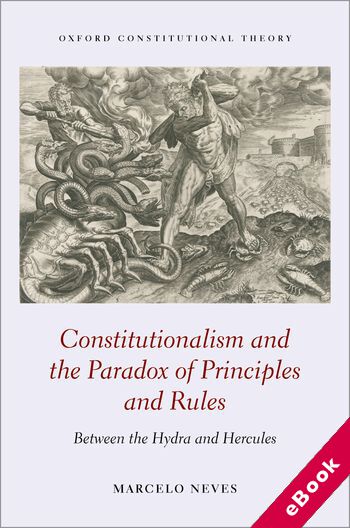
This title offers a unique approach to constitutionalism, focusing on the paradoxical relationship between principles and rules from the perspective of systems theory. It presents a critical counterpoint to Ronald Dworkin's principle-based theory, and in particular to Robert Alexy's idea of optimizing balancing. Instead of ceding to the compulsion of an optimizing balancing, it suggests the possibility of a comparative or at least 'satisficing' balancing, considering the precariousness of legal rationality. The book also reverses Dworkin's metaphor, associating rules with Hercules and principles with the Hydra. It takes constitutional principles seriously, criticizing the abuse of principles by the legal and constitutional doctrine and practice, and pointing out their relationship of complementarity and tension with rules. Finally, it offers an alternative model to the recent legal and constitutional theory on the basis of certain assumptions of the systems theory. It deals especially with the paradox of the circular and reflexive relationship between constitutional principles and rules: the former refers primarily to the openness and adequacy of legal system to society and thus to substantive argumentation; the second refers primarily to the closure and consistency of legal system and thus to formal argumentation.