The eBooks we sell are sold as a single-user licence and are intended for the end user only.
The sale of some eBooks are restricted to certain countries. To alert you to such restrictions, please select the country of the billing address of your credit or debit card you wish to use for payment.
For further information see https://www.wildy.com/ebook-formats
Once the order is confirmed an e-mail will be sent to you to allow you to download the eBook. For UK purchases this will be automatic. For purchases outside the UK a member of staff will need to confirm the sale. (Staff are available to do this during normal business hours, Mon-Fri 8:30-17:00 UK time)
All eBooks are supplied firm sale and cannot be returned. If you believe there is a fault with your eBook then contact us on ebooks@wildy.com and we will help in resolving the issue. This does not affect your statutory rights.
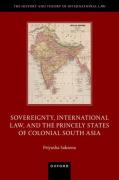
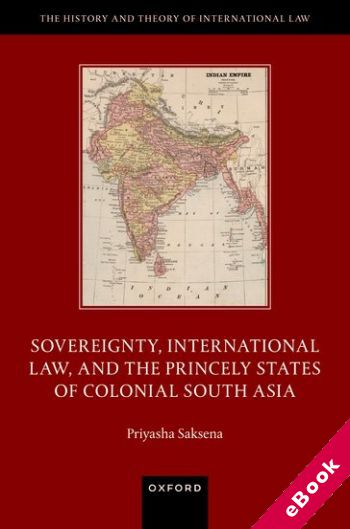
What constitutes a sovereign state in the international legal sphere? This question has been central to international law for centuries. Sovereignty, International Law, and the Princely States of Colonial South Asia provides a compelling exploration of the history of sovereignty through an analysis of the jurisdictional politics involving a specific set of historical legal entities.
Governed by local rulers, the princely states of colonial South Asia were subject to British paramountcy whilst remaining legally distinct from directly ruled British India. Their legal status and the extent of their rights remained the subject of feverish debates through the entirety of British colonial rule. This book traces the ways in which the language of sovereignty shaped the discourse surrounding the legal status of the princely states to illustrate how the doctrine of sovereignty came to structure political imagination in colonial South Asia and the framework of the modern Indian state.
Opening with a survey of the place of the princely states in the colonial structures of South Asia, Sovereignty, International Law, and the Princely States of Colonial South Asia goes on to illustrate how international lawyers, British politicians, colonial officials, rulers and bureaucrats of princely states, and anti-colonial nationalists in British India used definitions of sovereignty to construct political orders in line with their interests and aspirations. By invoking the vernacular of sovereignty in contrasting ways to support their differing visions of imperial and world order, these actors also attempted to reconfigure the boundaries among the spheres of the national, the imperial, and the international. Throughout the eighteenth, nineteenth, and early twentieth centuries, debates and disputes over the princely states continually defined and redefined the concept of sovereignty and international legitimacy in South Asia. Using rich material from the colonial archives, Sovereignty, International Law, and the Princely States of Colonial South Asia conveys an understanding of the history of sovereignty and the construction of the modern Indian nation-state that is still relevant today. A riveting read, this book will be of considerable interest and importance to scholars of international law and South Asia, legal historians, and political scientists.

![Cover of The Unseen History of International Law: A Census Bibliography of Hugo Grotius' De Iure Belli Ac Pacis [1625-1650 Editions] (eBook)](/static/oup/2025/9780198952077_sml.jpg)
![Cover of The Unseen History of International Law: A Census Bibliography of Hugo Grotius' De Iure Belli Ac Pacis [1625-1650 Editions]](/static/oup/2025/9780198952060_sml.jpg)