
The eBooks we sell are sold as a single-user licence and are intended for the end user only.
The sale of some eBooks are restricted to certain countries. To alert you to such restrictions, please select the country of the billing address of your credit or debit card you wish to use for payment.
For further information see https://www.wildy.com/ebook-formats
Once the order is confirmed an e-mail will be sent to you to allow you to download the eBook. For UK purchases this will be automatic. For purchases outside the UK a member of staff will need to confirm the sale. (Staff are available to do this during normal business hours, Mon-Fri 8:30-17:00 UK time)
All eBooks are supplied firm sale and cannot be returned. If you believe there is a fault with your eBook then contact us on ebooks@wildy.com and we will help in resolving the issue. This does not affect your statutory rights.
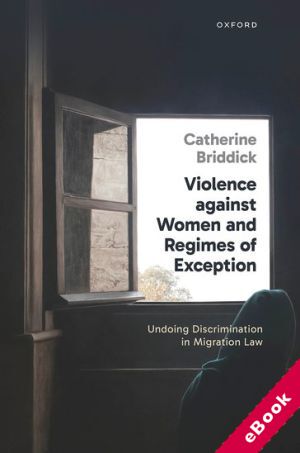
Violence against Women and Regimes of Exception provides a wide-ranging examination of how migration law discriminates against women, heightening their risk of being subjected to violence and intensifying their experiences of it. Catherine Briddick identifies patterns of disadvantage, scrutinizes justifications for differential treatment, and delineates legal obligations relating to violence against women.
Structured around the legal challenges that migrant women have brought to the regimes determining their status, this book reveals the devastating impact of flawed rules that increase vulnerability to violence, deny effective protection, and render victims at risk of destitution, detention, and deportation. Integrating doctrinal, empirical, and theoretical material, it explores the difference that migration status makes to an experience of violence, investigates where existing regimes fall short, and establishes how the resulting compounded disadvantage should be remedied.
The analysis begins in the UK and with the European Convention on Human Rights, broadening to connect with European Union law and the Council of Europe's Trafficking and Istanbul Conventions. This approach provides valuable insights into the role and ability of national courts, the European Court of Human Rights, and the Court of Justice of the European Union to scrutinize different forms of discriminatory treatment. By bringing together distinct responses to violence experienced in the context of migration control, the book outlines a new framework for their evaluation and determines how rights and protection could better be secured.
A groundbreaking work that centres the experiences of those marginalized by migration law, this is essential reading for anyone interested in the intersection of violence, gender, and migration.










