
The eBooks we sell are sold as a single-user licence and are intended for the end user only.
The sale of some eBooks are restricted to certain countries. To alert you to such restrictions, please select the country of the billing address of your credit or debit card you wish to use for payment.
For further information see https://www.wildy.com/ebook-formats
Once the order is confirmed an e-mail will be sent to you to allow you to download the eBook. For UK purchases this will be automatic. For purchases outside the UK a member of staff will need to confirm the sale. (Staff are available to do this during normal business hours, Mon-Fri 8:30-17:00 UK time)
All eBooks are supplied firm sale and cannot be returned. If you believe there is a fault with your eBook then contact us on ebooks@wildy.com and we will help in resolving the issue. This does not affect your statutory rights.
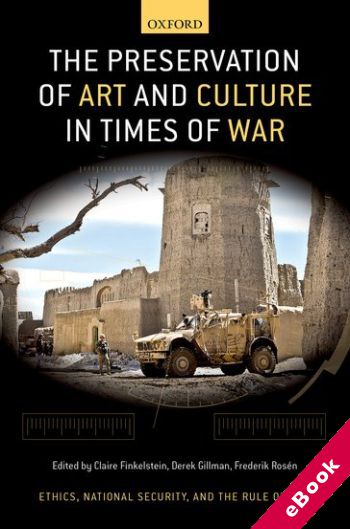
Conflict over cultural heritage has increasingly become a standard part of war. Today, systematic exploitation, manipulation, attacks, and destruction of cultural heritage by state and non-state actors form part of most violent conflicts across the world. Such acts are often intentional and based on well-planned strategies for inflicting harm on groups of people and communities.
With this increasing awareness of the role cultural heritage plays in war, scholars and practitioners have progressed from seeing conflict-related destruction of cultural heritage as a cultural tragedy to understanding it as a vital national security issue. There is also a shift from the desire to protect cultural property for its own sake to viewing its protection as connected to broader agendas of peace and security. Concerns about cultural heritage have thus migrated beyond the cultural sphere to worries about the protection of civilians, the financing of terrorism, societal resilience, post-conflict reconciliation, hybrid warfare, and the geopolitics of territorial conflicts. This volume seeks to deepen public understanding of the evolving nexus between cultural heritage and security in the twenty-first century.
Drawing on a variety of disciplines and perspectives, the chapters in this volume examine a complex set of relationships between the deliberate destruction and misuse of cultural heritage in times of conflict, on the one hand, and basic societal values, legal principles, and national security, on the other.










