
The eBooks we sell are sold as a single-user licence and are intended for the end user only.
The sale of some eBooks are restricted to certain countries. To alert you to such restrictions, please select the country of the billing address of your credit or debit card you wish to use for payment.
For further information see https://www.wildy.com/ebook-formats
Once the order is confirmed an e-mail will be sent to you to allow you to download the eBook. For UK purchases this will be automatic. For purchases outside the UK a member of staff will need to confirm the sale. (Staff are available to do this during normal business hours, Mon-Fri 8:30-17:00 UK time)
All eBooks are supplied firm sale and cannot be returned. If you believe there is a fault with your eBook then contact us on ebooks@wildy.com and we will help in resolving the issue. This does not affect your statutory rights.
Due to a technical issue some ebooks are not available to order.
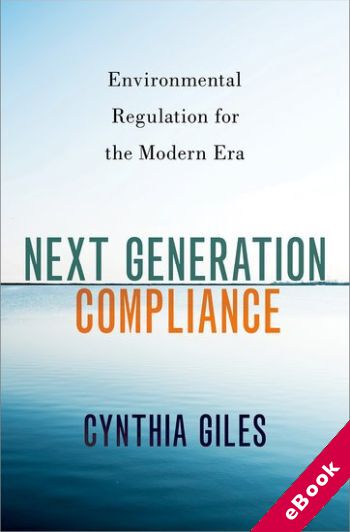
Nearly everyone accepts as gospel two assumptions: compliance with environmental rules is high, and enforcement is responsible for making compliance happen. Both are wrong. In fact, serious violations of environmental regulations are widespread, and by far the most important driver of compliance results is not enforcement but the structure of the rule itself.
In Next Generation Compliance, Cynthia Giles shows that well-designed regulations deploying creative strategies to make compliance the default can achieve excellent implementation outcomes. Poorly designed rules that create many opportunities to evade, obfuscate, or ignore will have dismal performance that no amount of enforcement will ever fix.
Rampant violations have real consequences: unhealthy air, polluted water, contaminated drinking water, exposure to dangerous chemicals, and unrestrained climate-forcing pollution. They also land hardest on already overburdened communities - that's why Next Gen and environmental justice are tightly linked.
The good news is there are tools to build much better compliance into regulations, including many tested strategies that can be the building blocks of programs that withstand the inevitable pressures of real life. Next Generation Compliance shows how regulators can avoid the compliance calamities that plague far too many environmental rules today, a lesson that is particularly urgent for regulations tackling climate change. It has an optimistic message: there are ways to ensure reliable results, if regulators jettison incorrect assumptions and design rules that are resilient to the mess and complexity of the real world.










