
The eBooks we sell are sold as a single-user licence and are intended for the end user only.
The sale of some eBooks are restricted to certain countries. To alert you to such restrictions, please select the country of the billing address of your credit or debit card you wish to use for payment.
For further information see https://www.wildy.com/ebook-formats
Once the order is confirmed an e-mail will be sent to you to allow you to download the eBook. For UK purchases this will be automatic. For purchases outside the UK a member of staff will need to confirm the sale. (Staff are available to do this during normal business hours, Mon-Fri 8:30-17:00 UK time)
All eBooks are supplied firm sale and cannot be returned. If you believe there is a fault with your eBook then contact us on ebooks@wildy.com and we will help in resolving the issue. This does not affect your statutory rights.
Due to a technical issue some ebooks are not available to order.
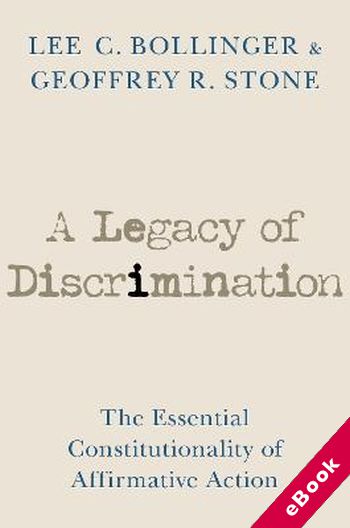
A timely defense of affirmative action policies that offers a more nuanced understanding of how centuries of invidious racism, discrimination, and segregation in the United States led to and justifies such policies from both a moral and constitutional perspective. Since 1961, the issue of "affirmative action" has been a hotly contested legal and political issue. Intended to address our nation's often horrifying discrimination against Black Americans and other minorities, affirmative action has led over the past sixty years to far greater minority representation across a vast range of industries, government positions, and academic institutions. Nonetheless, affirmative action policies in the United States continue to fall under assault. In A Legacy of Discrimination, Lee C. Bollinger and Geoffrey R. Stone, two of America's leading constitutional scholars, trace the policy's history and the legal challenges it has faced over the decades. They argue that in order to fully comprehend affirmative action's original intent and impact, we must re-acquaint ourselves with the era in which it arose, beginning with the most important Supreme Court decision of the 20th century, 1954's Brown v. Board of Education of Topeka, Kansas. Assessing this history, Bollinger and Stone introduce subsequent, and evolving, affirmative-action case law that had the intent and effect of constraining social, educational, and economic progress for Black people and other minority groups. They demonstrate how and why affirmative action policies stand on firm legal ground and must remain protected. Further, they explain why Americans must view affirmative action as a long-term moral commitment to secure justice, especially for Black Americans, after three and a half centuries of grave injustice that violates the most essential aspirations of our nation. A timely and robust overview of the history of our nation's historical and continuing racial discrimination and of the advent of affirmative action as a critical means to address this history, this book will serve as a powerful defense of a policy that has accomplished more than most people realize in making America a fairer and more inclusive country.










