
The eBooks we sell are sold as a single-user licence and are intended for the end user only.
The sale of some eBooks are restricted to certain countries. To alert you to such restrictions, please select the country of the billing address of your credit or debit card you wish to use for payment.
For further information see https://www.wildy.com/ebook-formats
Once the order is confirmed an e-mail will be sent to you to allow you to download the eBook. For UK purchases this will be automatic. For purchases outside the UK a member of staff will need to confirm the sale. (Staff are available to do this during normal business hours, Mon-Fri 8:30-17:00 UK time)
All eBooks are supplied firm sale and cannot be returned. If you believe there is a fault with your eBook then contact us on ebooks@wildy.com and we will help in resolving the issue. This does not affect your statutory rights.
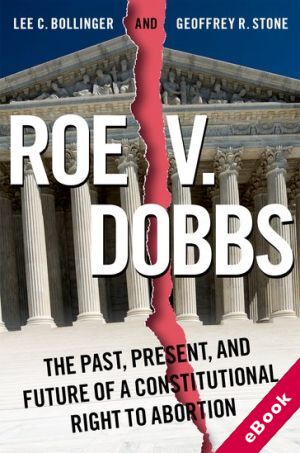
With this volume, Roe v. Dobbs: The Past, Present and Future of a Constitutional Right of Abortion, we confront the remarkable beginning and end—once again, after a half-century-of the landmark Supreme Court decision in Roe v. Wade, shockingly overruled by the Court in Dobbs v. Jackson Women's Health Organization. The goal of this book is to bring together some of our nation's leading constitutional scholars, historians, philosophers, and medical experts to share their views on whether there should be a constitutional right to abortion and what the consequences of Dobbs might be.
What makes this subject unique is how it intersects with our own lives, since both Bollinger and Stone were law clerks at the Supreme Court in the year that Roe was decided (1973)—Stone for Justice William Brennan and Bollinger for Chief Justice Warren Burger. During the Court's 1972 Term, when Roe was decided, the Court was in a state of flux. President Nixon had just appointed four Justices to the Court—Burger, Blackmun, Powell, and Rehnquist. The era of the Warren Court was clearly over. In those days, the Justices were non-partisan, often joined opinions across the political/ideological spectrum, and approached cases with an open mind. That in large part explains why the Court could reach the decision it did in Roe, with five of the six Republican-appointed Justices and two of the three Democratic-appointed Justices in the majority, and one Republican-appointed justice (Rehnquist) and one Democratic-appointed justice (White) in dissent. It was a different Court and a different era.










