
The eBooks we sell are sold as a single-user licence and are intended for the end user only.
The sale of some eBooks are restricted to certain countries. To alert you to such restrictions, please select the country of the billing address of your credit or debit card you wish to use for payment.
For further information see https://www.wildy.com/ebook-formats
Once the order is confirmed an e-mail will be sent to you to allow you to download the eBook. For UK purchases this will be automatic. For purchases outside the UK a member of staff will need to confirm the sale. (Staff are available to do this during normal business hours, Mon-Fri 8:30-17:00 UK time)
All eBooks are supplied firm sale and cannot be returned. If you believe there is a fault with your eBook then contact us on ebooks@wildy.com and we will help in resolving the issue. This does not affect your statutory rights.
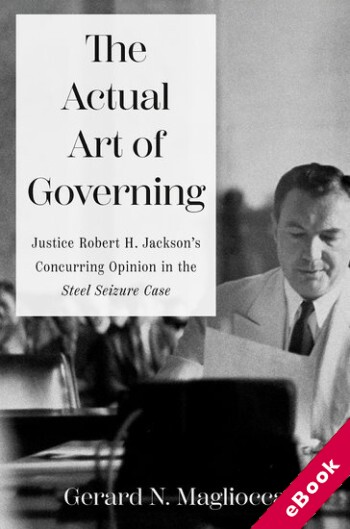
Since the adoption of the US constitution, there has been ongoing calibration of the power balance between the three branches of government, often in the face of rapidly changing social and political contexts. In 1952, US Supreme Court Justice Robert H. Jackson took up this debate in Youngstown Sheet & Tube Company v. Sawyer, a watershed case that barred President Harry S. Truman from seizing privately operated steel mills during the Korean War. Concurring with the majority decision, Jackson penned an opinion that would become the authoritative source on the constitutional boundary between congressional and executive authority.
In The Actual Art of Governing, eminent legal historian Gerard N. Magliocca takes a close look at this landmark opinion, providing a deep reading of the decision and the context surrounding it, and explaining its lasting influence. Magliocca skillfully shows how Justice Jackson's opinion broke free of the rules for judicial writing, taking a pragmatic approach to constitutional interpretation that drew on personal experience and historical examples, rather than sticking strictly to the text, judicial doctrine, and original public meaning. The framework that Jackson proposed took on crucial significance during the fallout of Richard Nixon's Watergate abuses and has continued to be relied upon in controversies involving the reach of the US President's power, including actions taken by Donald Trump. Magliocca concludes by arguing that a proper reading of Jackson's Youngstown concurrence would lead to significant curbs on emergency powers, the discretion of the federal courts, and presidential authority.










