
The eBooks we sell are sold as a single-user licence and are intended for the end user only.
The sale of some eBooks are restricted to certain countries. To alert you to such restrictions, please select the country of the billing address of your credit or debit card you wish to use for payment.
For further information see https://www.wildy.com/ebook-formats
Once the order is confirmed an e-mail will be sent to you to allow you to download the eBook. For UK purchases this will be automatic. For purchases outside the UK a member of staff will need to confirm the sale. (Staff are available to do this during normal business hours, Mon-Fri 8:30-17:00 UK time)
All eBooks are supplied firm sale and cannot be returned. If you believe there is a fault with your eBook then contact us on ebooks@wildy.com and we will help in resolving the issue. This does not affect your statutory rights.
When you visit a website, check your email, or download music, you enter into a contract that you probably don't know exists.
Wrap contracts - shrinkwrap, clickwrap and browsewrap agreements - are non-traditional contracts that look nothing like legal documents. Contrary to what courts have held, they are not "just like" other standard form contracts, and consumers do not perceive them the same way. Wrap contract terms are more aggressive and permit dubious business practices, such as the collection of personal information and the appropriation of user-created content.
In digital form, wrap contracts are weightless and cheap to reproduce. Given their low cost and flexible form, businesses engage in "contracting mania" where they use wrap contracts excessively and in a wide variety of contexts. Courts impose a duty to read upon consumers but don't impose a duty upon businesses to make contracts easy to read. The result is that consumers are subjected to onerous legalese for nearly every online interaction.
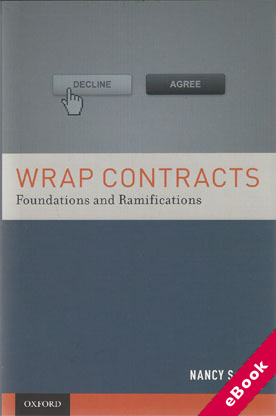
In Wrap Contracts: Foundations and Ramifications, Nancy Kim explains why wrap contracts were created, how they have developed, and what this means for society. She explains how businesses and existing law unfairly burden users and create a coercive contracting environment that forces users to "accept" in order to participate in modern life.
Kim's central thesis is that how a contract is presented affects and reveals the intent of the parties. She proposes doctrinal solutions - such as the duty to draft reasonably, specific assent, and a reconceptualization of unconscionability - which fairly balance the burden of wrap contracts between businesses and consumers.










