
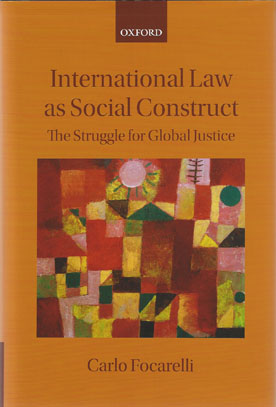
The book distils and articulates international law as a social construct. It does so by analysing its social foundations, essence, and roots in practical and socially workable (as opposed to 'pure') reason.
In addition to well-known doctrines of jurisprudence and international law, it draws upon psycho-analytic insights into the origins and nature of law, as well as philosophical social constructivism. The work suggests that seeing law as a social construct is crucial to our understanding of international law and to the struggle to create better working rules.
The book re-conceptualizes both past and new doctrines of international law as 'constructs', namely, as strategies of concomitantly de-mythologizing and re-mythologizing international law. Key areas of international law, including subjects, sources, hierarchy, values, and remedies, are shown to be part of this process.
The social impact on international law of transnational actors and stakeholders, normative fragmentation, global justice, legitimacy of both rules and players, dynamics and hierarchization of norms, compliance and implementation in municipal law is also extensively investigated. Five basic values of the international community, namely security, humanity, wealth, environment, and knowledge, are explored by stressing their inter- and intra-tensions.
Finally, the analysis is extended to the role that international courts play in the prosecution of heads of state and other transnational players who violate international law.










