
The eBooks we sell are sold as a single-user licence and are intended for the end user only.
The sale of some eBooks are restricted to certain countries. To alert you to such restrictions, please select the country of the billing address of your credit or debit card you wish to use for payment.
For further information see https://www.wildy.com/ebook-formats
Once the order is confirmed an e-mail will be sent to you to allow you to download the eBook. For UK purchases this will be automatic. For purchases outside the UK a member of staff will need to confirm the sale. (Staff are available to do this during normal business hours, Mon-Fri 8:30-17:00 UK time)
All eBooks are supplied firm sale and cannot be returned. If you believe there is a fault with your eBook then contact us on ebooks@wildy.com and we will help in resolving the issue. This does not affect your statutory rights.
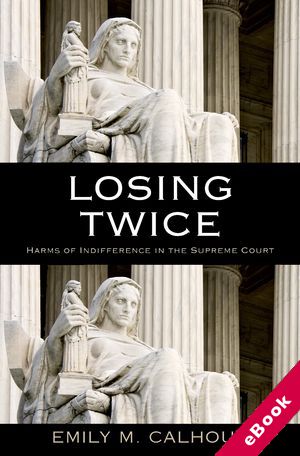
Constitutional 'losers' represent a thorny and longstanding problem in American constitutional law. Given our adversarial system, the way that rights cases are decided means that regardless of whether a losing side has committed any actions that cause harm to others, they typically suffer unnecessary harm as a consequence of decisions. In areas such as affirmative action and gay rights, the losers are essentially punished for losing despite neither intending nor causing injury.
In Losing Twice, Emily Calhoun draws upon conflict resolution theory, political theory, and Habermasian discourse theory to argue that in such cases, the Court must work harder to avoid inflicting unnecessary harm on Constitutional losers. But for this to happen, Calhoun contends, the role of judges needs to be reconceptualized. She contends that the Court should not perceive itself simply as an adversarial forum, but also as a 'transactional' one, where losers are not simply losers but participants in a process capable of addressing and ameliorating the effects that come with loss. Filled with lucid discussions of well known cases, Losing Twice offers an intellectually powerful argument for transforming the decision-making process in Constitutional rights disputes.










