
The eBooks we sell are sold as a single-user licence and are intended for the end user only.
The sale of some eBooks are restricted to certain countries. To alert you to such restrictions, please select the country of the billing address of your credit or debit card you wish to use for payment.
For further information see https://www.wildy.com/ebook-formats
Once the order is confirmed an e-mail will be sent to you to allow you to download the eBook. For UK purchases this will be automatic. For purchases outside the UK a member of staff will need to confirm the sale. (Staff are available to do this during normal business hours, Mon-Fri 8:30-17:00 UK time)
All eBooks are supplied firm sale and cannot be returned. If you believe there is a fault with your eBook then contact us on ebooks@wildy.com and we will help in resolving the issue. This does not affect your statutory rights.
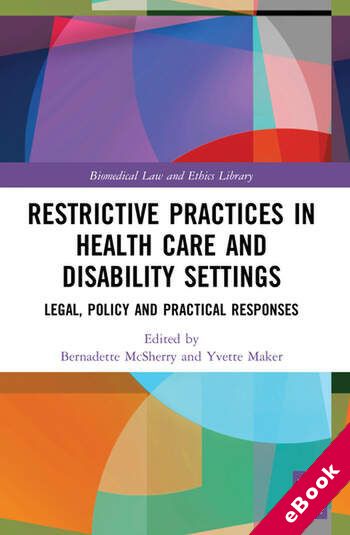
This volume explores different models of regulating the use of restrictive practices in health care and disability settings.
The authors examine the legislation, policies, inspection, enforcement and accreditation of the use of practices such as physical, mechanical and chemical restraint. They also explore the importance of factors such as organisational culture and staff training to the effective implementation of regulatory regimes. In doing so, the collection provides a solid evidence base for both the development and implementation of effective approaches to restrictive practices that focus on their reduction and, ultimately, their elimination across health care sectors. Divided into five parts, the volume covers new ground in multiple respects. First, it addresses the use of restrictive practices across mental health, disability and aged care settings, creating opportunities for new insights and interdisciplinary conversations across traditionally siloed sectors. Second, it includes contributions from research academics, clinicians, regulators and mental health consumers, offering a rich and comprehensive picture of existing regulatory regimes and options for designing and implementing regulatory approaches that address the failings of current systems. Finally, it incorporates comparative perspectives from Australia, New Zealand, the Netherlands, Germany and England.
The book is an invaluable resource for regulators, policymakers, lawyers, clinicians, consumer advocates and academics grappling with the use and regulation of restrictive practices in mental health, disability and aged care contexts.











