
The eBooks we sell are sold as a single-user licence and are intended for the end user only.
The sale of some eBooks are restricted to certain countries. To alert you to such restrictions, please select the country of the billing address of your credit or debit card you wish to use for payment.
For further information see https://www.wildy.com/ebook-formats
Once the order is confirmed an e-mail will be sent to you to allow you to download the eBook. For UK purchases this will be automatic. For purchases outside the UK a member of staff will need to confirm the sale. (Staff are available to do this during normal business hours, Mon-Fri 8:30-17:00 UK time)
All eBooks are supplied firm sale and cannot be returned. If you believe there is a fault with your eBook then contact us on ebooks@wildy.com and we will help in resolving the issue. This does not affect your statutory rights.
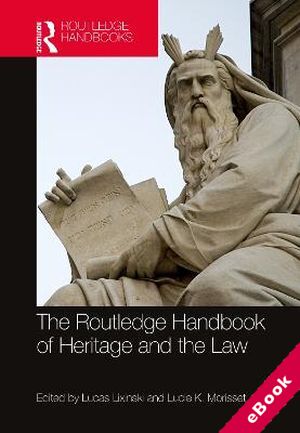
The Routledge Handbook of Heritage and the Law sheds light on the relationship between the two fields and analyses how the law shapes heritage and heritage practice in both expected and unexpected ways.
Including contributions from 41 authors working across a range of jurisdictions, the volume analyses the law as a transnational phenomenon and uses international and comparative legal methodologies to distil lessons for broad application. Demonstrating that the law is fundamentally a language of power and contestation, the Handbook shows how this impacts our views of heritage. It also shows that, to understand the ways in which the law impacts key aspects of heritage practice, it is important to tap into the possibilities of heritage as points of convergence of identity, struggles over resources, and the distribution of power. Framing heritage as a driver for legal engagement, rather than a passive regulatory object, the book’s three parts first reviews the legal fields or mechanisms that can shape action in the heritage field, then questions how these enable authority and give power to those who seize heritage, and finally envisions how the discussion between heritage and the law can lay new grounds in both those fields. Lifting the mists that often render the law opaque in heritage studies, the Handbook showcases the law as a medium through which the culture and the power of heritage are expressed and might be shared.
The Routledge Handbook of Heritage and the Law presents a view of the law that is aimed at those who wish to reflect on how law has changed, or could change, what heritage is and how it can support social, cultural, local, or other development. It will be of interest to scholars, students, policymakers, and practitioners working in the areas of museum studies, heritage studies and urban studies, as well as in cultural intervention and planning.










