Due to the current Microsoft incident we are unable to access Email and also the supply of some eBooks may be delayed as well as our ability to process online payments - You can still call the shop on (020) 7242 5778 (08.30-17:00). Last updated 13/11/26 11:30 GMT
The eBooks we sell are sold as a single-user licence and are intended for the end user only.
The sale of some eBooks are restricted to certain countries. To alert you to such restrictions, please select the country of the billing address of your credit or debit card you wish to use for payment.
For further information see https://www.wildy.com/ebook-formats
Once the order is confirmed an e-mail will be sent to you to allow you to download the eBook. For UK purchases this will be automatic. For purchases outside the UK a member of staff will need to confirm the sale. (Staff are available to do this during normal business hours, Mon-Fri 8:30-17:00 UK time)
All eBooks are supplied firm sale and cannot be returned. If you believe there is a fault with your eBook then contact us on ebooks@wildy.com and we will help in resolving the issue. This does not affect your statutory rights.
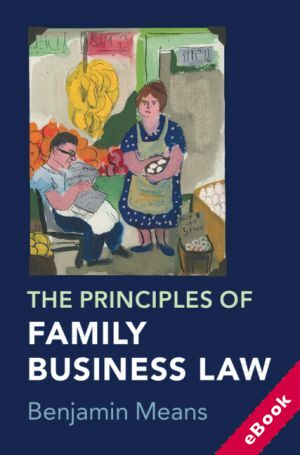
The Principles of Family Business Law offers an accessible approach to legal issues that shape family businesses. Drawing on years of research, the book introduces three principles – intimacy, integration, and inheritance – that explain why family businesses are distinctive and how, with proper guidance, they can thrive. The book examines recurring problems such as role conflicts among family members, succession planning obstacles, and ownership disputes. Vivid case studies illustrate how legal rules interact with family dynamics in practice.
Designed for scholars, students, lawyers, and business advisors, the book integrates insights from corporate law, family law, and estate planning, while remaining readable and grounded in real-world concerns. Whether used in the classroom or in practice, it provides essential tools for navigating the complex interplay of law and family business. By supporting the resilience of family businesses, the book affirms the family and community values they help to sustain.
Benjamin Means is Professor of Law and John T. Campbell Chair in Business and Professional Ethics at the Joseph F. Rice School of Law at the University of South Carolina.