The eBooks we sell are sold as a single-user licence and are intended for the end user only.
The sale of some eBooks are restricted to certain countries. To alert you to such restrictions, please select the country of the billing address of your credit or debit card you wish to use for payment.
For further information see https://www.wildy.com/ebook-formats
Once the order is confirmed an e-mail will be sent to you to allow you to download the eBook. For UK purchases this will be automatic. For purchases outside the UK a member of staff will need to confirm the sale. (Staff are available to do this during normal business hours, Mon-Fri 8:30-17:00 UK time)
All eBooks are supplied firm sale and cannot be returned. If you believe there is a fault with your eBook then contact us on ebooks@wildy.com and we will help in resolving the issue. This does not affect your statutory rights.
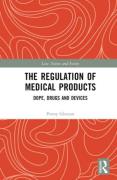
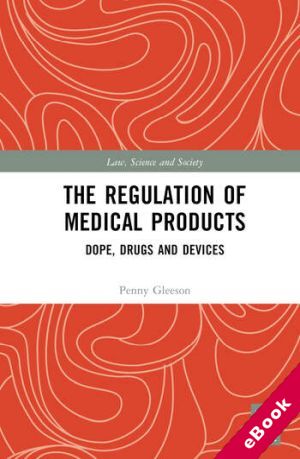
This book develops a theoretical framework for examining and assessing the regulatory arrangements for medical products.
Since the first half of the 20th century, the regulation of pharmaceuticals, medical devices and, more recently, biologicals have been controlled in many jurisdictions by specific regulatory regimes and agencies. Their regulatory mandates are similar - to ensure the quality, safety and efficacy of medical products. This book provides a timely and relevant assessment of the complexities of medical regulatory regimes, by drawing on a particular theory of political legitimacy. In this respect, the book adopts a ‘dialogic’ approach – according to which a shared set of normative beliefs and values are formulated – as a theoretical ‘tool’ to identify deficiencies in the regulatory arrangements for medical products. Drawing on several Australian cases studies, characterised by divergent normative perspectives, the book develops its dialogic approach in order to challenge the usual legitimation of regulatory regimes from the perspective of science alone. Specifically, it maintains that such regimes need to embrace a normative pluralism that admits a diversity of types and sources of knowledge.
This evaluation of the increasingly influential domain of medical regulation will appeal to a range of scholars and practitioners working in law, public health, politics and science and technology studies.