
The eBooks we sell are sold as a single-user licence and are intended for the end user only.
The sale of some eBooks are restricted to certain countries. To alert you to such restrictions, please select the country of the billing address of your credit or debit card you wish to use for payment.
For further information see https://www.wildy.com/ebook-formats
Once the order is confirmed an e-mail will be sent to you to allow you to download the eBook. For UK purchases this will be automatic. For purchases outside the UK a member of staff will need to confirm the sale. (Staff are available to do this during normal business hours, Mon-Fri 8:30-17:00 UK time)
All eBooks are supplied firm sale and cannot be returned. If you believe there is a fault with your eBook then contact us on ebooks@wildy.com and we will help in resolving the issue. This does not affect your statutory rights.
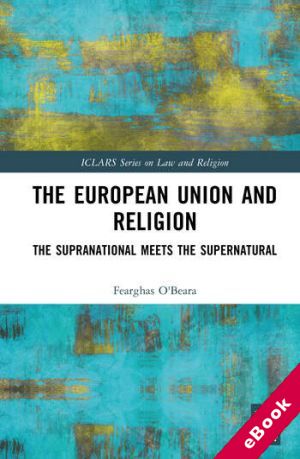
This book takes a multidisciplinary approach to explore why the EU increased its entanglement with religion while many Member States – particularly in Western Europe - were decreasing theirs. It explains the complex relationship between two parallel evolving socio-political phenomena – European integration and secularisation – by drawing from the disciplines of constitutional law, sociology of religion, political science, and International Relations. Qualitative evidence was obtained through interviews with officials of the EU Commission, Parliament and External Action Service working on religious engagement, as well as with the EU’s key religious partner organisations. The author draws together evidence from these diverse sources to describe the EU’s sui generis religion-state model, distinct from Member State ones.
The book shows the EU operates pragmatically, free of ideological or historical constraints, and positively views ethical contributions to its policies and laws from religion. The EU identifies as a community of values and seeks democratic legitimacy; it sees religions as carriers of values and sources of European identity, potentially aiding its state-building efforts. The book concludes by looking at what to expect of this engagement from the EU executive and legislature in the future. The book will be of interest to researchers and academics working in the areas of Law and Religion, Philosophy of Law, Constitutional Law, Sociology of Religion, Political Science, International Relations and European Studies.











