The eBooks we sell are sold as a single-user licence and are intended for the end user only.
The sale of some eBooks are restricted to certain countries. To alert you to such restrictions, please select the country of the billing address of your credit or debit card you wish to use for payment.
For further information see https://www.wildy.com/ebook-formats
Once the order is confirmed an e-mail will be sent to you to allow you to download the eBook. For UK purchases this will be automatic. For purchases outside the UK a member of staff will need to confirm the sale. (Staff are available to do this during normal business hours, Mon-Fri 8:30-17:00 UK time)
All eBooks are supplied firm sale and cannot be returned. If you believe there is a fault with your eBook then contact us on ebooks@wildy.com and we will help in resolving the issue. This does not affect your statutory rights.
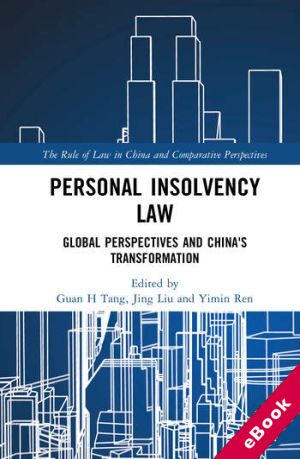
In an era marked by economic uncertainty and rising living costs, the need for compassionate and effective personal insolvency systems has never been more urgent. This edited volume offers a timely and incisive exploration of the complexities of personal insolvency regimes.
Drawing on insights from the UK, the US, Europe, Japan and China, the book examines how diverse legal systems negotiate the tensions between debt relief and moral hazard, creditor protection and social equity, and market efficiency and human dignity. It compares the effectiveness of neoliberal models, middle-ground approaches, and state-led systems, offering assessments of their respective strengths and limitations.
The analysis moves beyond theory, grounding its arguments in real-world examples, while advancing the case for a robust, standalone personal insolvency framework in China. By synthesising global experience with local experimentation, the volume demonstrates how such a framework could strengthen economic resilience, uphold human dignity, and bring China’s system into closer alignment with international standards.
Ideal for scholars, policymakers and practitioners alike, this book bridges academic rigour and practical relevance, inviting readers to reconsider insolvency not merely as a mechanism of last resort, but as an instrument of financial rehabilitation and social inclusion.