
The eBooks we sell are sold as a single-user licence and are intended for the end user only.
The sale of some eBooks are restricted to certain countries. To alert you to such restrictions, please select the country of the billing address of your credit or debit card you wish to use for payment.
For further information see https://www.wildy.com/ebook-formats
Once the order is confirmed an e-mail will be sent to you to allow you to download the eBook. For UK purchases this will be automatic. For purchases outside the UK a member of staff will need to confirm the sale. (Staff are available to do this during normal business hours, Mon-Fri 8:30-17:00 UK time)
All eBooks are supplied firm sale and cannot be returned. If you believe there is a fault with your eBook then contact us on ebooks@wildy.com and we will help in resolving the issue. This does not affect your statutory rights.
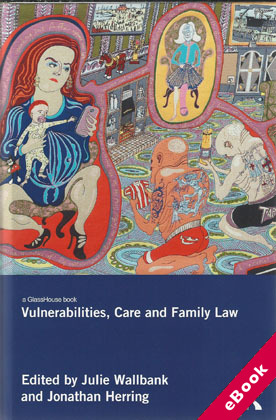
While in the past family life was characterised as a "haven from the harsh realities of life", it is now recognised as a site of vulnerabilities and a place where care work can go unacknowledged and be a source of social and economic hardship.
Vulnerabilities, Care and Family Law addresses the strong relationships that exist between vulnerability and care and dependency in particular contexts, where family law and social policy have a contribution to make.
A fundamental premise of this collection is that vulnerability needs to be analysed in a way that gets at the heart of the differential power relationships that exist in society, particularly in respect of access to family justice, including effective social policy and law, targeted at the specific needs of families in mutually dependent caring relationships.
It is, therefore, crucial to critically examine the various approaches taken by policy makers and law reformers in order to understand the range of ways that some families, and some family members, may be rendered more vulnerable than others. The first book of its kind to provide an intersectional approach to this subject, Vulnerabilities, Care and Family Law will be of interest to anyone concerned with how developments in social policy and family law might improve the lives of already exposed and fragile families.










