
The eBooks we sell are sold as a single-user licence and are intended for the end user only.
The sale of some eBooks are restricted to certain countries. To alert you to such restrictions, please select the country of the billing address of your credit or debit card you wish to use for payment.
For further information see https://www.wildy.com/ebook-formats
Once the order is confirmed an e-mail will be sent to you to allow you to download the eBook. For UK purchases this will be automatic. For purchases outside the UK a member of staff will need to confirm the sale. (Staff are available to do this during normal business hours, Mon-Fri 8:30-17:00 UK time)
All eBooks are supplied firm sale and cannot be returned. If you believe there is a fault with your eBook then contact us on ebooks@wildy.com and we will help in resolving the issue. This does not affect your statutory rights.
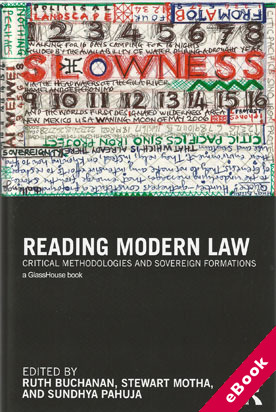
Reading Modern Law addresses the identification and elaboration of a critical methodology for reading and writing about law in modernity.
While the force of law rests on determinate and localizable authorizations, as well as an expansive capacity to encompass what has not been pre-figured by an order of rules, the key question this dynamic of law raises is how legal forms might be deployed to confront and disrupt injustice.
The urgency of this question must not eclipse the care its complexity demands. This book, whilst testifying to that complexity, offers a critical methodology for addressing its many challenges.
The essays in this volume – all direct or oblique engagements with the work of Peter Fitzpatrick – chart a mode of resisting the imperialism of social scientific method, as much as geo-political empire. Their authors elaborate a critical and interdisciplinary treatment of law and modernity, and outline the pivotal role of sovereignty in contemporary formations of power, both national and international. From various overlapping vantage points, therefore, Reading Modern Law interrogates law’s relationship to power, as well as its relationship to the critical work of reading and writing about law in modernity.










