
The eBooks we sell are sold as a single-user licence and are intended for the end user only.
The sale of some eBooks are restricted to certain countries. To alert you to such restrictions, please select the country of the billing address of your credit or debit card you wish to use for payment.
For further information see https://www.wildy.com/ebook-formats
Once the order is confirmed an e-mail will be sent to you to allow you to download the eBook. For UK purchases this will be automatic. For purchases outside the UK a member of staff will need to confirm the sale. (Staff are available to do this during normal business hours, Mon-Fri 8:30-17:00 UK time)
All eBooks are supplied firm sale and cannot be returned. If you believe there is a fault with your eBook then contact us on ebooks@wildy.com and we will help in resolving the issue. This does not affect your statutory rights.
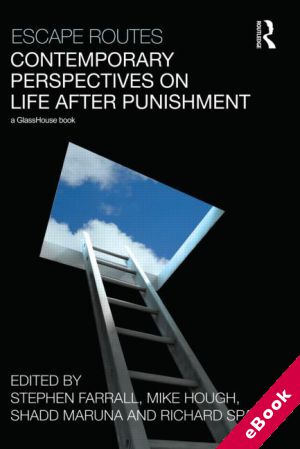
Escape Routes: Contemporary Perspectives on Life After Punishment addresses the reasons why people stop offending, and the processes by which they are rehabilitated or resettled back into the community. Engaging with, and building upon, renewed criminological interest in this area, Escape Routes nevertheless broadens and enlivens the current debate. First, its scope goes beyond a narrowly-defined notion of crime and includes, for example, essays on religious redemption, the lives of ex-war criminals, and the relationship between ethnicity and desistance from crime. Second, contributors to this volume draw upon a number of areas of contemporary research, including urban studies, philosophy, history, religious studies, and ethics, as well as criminology. Examining new theoretical work in the study of desistance and exploring the experiences of a number of groups whose experiences of life after punishment do not usually attract much attention, Escape Routes provides new insights about the processes associated with reform, resettlement and forgiveness. Intended to drive our understanding of life after punishment forward, its rich array of theoretical and substantive papers will be of considerable interest to criminologists, lawyers, and sociologists.










