
Wildy Logo
(020) 7242 5778
enquiries@wildy.com

Book of the Month

Cover of Toulson & Phipps on Confidentiality

Toulson & Phipps on Confidentiality

Price: £175.00

Advocacy: A Practical
Guide 2nd ed


 Peter Lyons, Chris Taylor


Welcome to Wildys

Watch


Judicial Cooperation in Commercial Litigation 3rd ed (The British Cross-Border Financial Centre World)


 Ian Kawaley, David Doyle, Shade Subair Williams


Offers for Newly Called Barristers & Students

Special Discounts for Newly Called & Students

Read More ...


Secondhand & Out of Print

Browse Secondhand Online

Read More...


Easter Holiday Closing

We will be closed from 5pm BST on Thursday 2nd April for the Easter bank holidays, re-opening at 8.30am BST on Tuesday 7th April. Any orders placed during this period will be processed when we re-open.

Hide this message

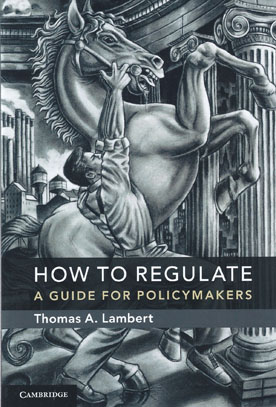
How to Regulate: A Guide for Policymakers


ISBN13: 9781316508008
Published: August 2017
Publisher: Cambridge University Press
Country of Publication: USA
Format: Paperback
Price: £36.00


Despatched in 6 to 8 days.

Markets sometimes fail. But so do regulatory efforts to correct market failures. Sometimes regulations reach too far, condemning good activities as well as bad, and sometimes they don't reach far enough, allowing bad behavior to persist.

In this highly instructive book, Thomas A. Lambert explains the pitfalls of both extremes while offering readers a manual of effective regulation, showing how the best regulation maximizes social welfare and minimizes social costs. Working like a physician, Lambert demonstrates how regulators should diagnose the underlying disease and identify its symptoms, potential remedies, and side effects before selecting the regulation that offers the greatest net benefit.

This book should be read by policymakers, students, and anyone else interested in understanding how the best regulations are crafted and why they work.


Subjects:
Other Jurisdictions , USA
Contents:
1. Defining our subject
2. The overarching model
3. The private ordering ideal
4. Externalities
5. Public (and quasi-public) goods
6. Agency costs
7. Market power
8. Information asymmetry
9. Cognitive limitations and behavioral quirks
Conclusion. Closing thoughts on open questions.









