
The eBooks we sell are sold as a single-user licence and are intended for the end user only.
The sale of some eBooks are restricted to certain countries. To alert you to such restrictions, please select the country of the billing address of your credit or debit card you wish to use for payment.
For further information see https://www.wildy.com/ebook-formats
Once the order is confirmed an e-mail will be sent to you to allow you to download the eBook. For UK purchases this will be automatic. For purchases outside the UK a member of staff will need to confirm the sale. (Staff are available to do this during normal business hours, Mon-Fri 8:30-17:00 UK time)
All eBooks are supplied firm sale and cannot be returned. If you believe there is a fault with your eBook then contact us on ebooks@wildy.com and we will help in resolving the issue. This does not affect your statutory rights.
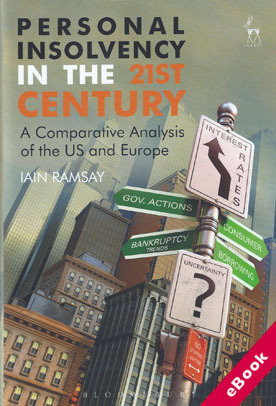
Since 1979 the world has witnessed a remarkable cycle of individual bankruptcy law reform. Changes in capitalist economies, financial crises and political interest groups all contributed to this cycle of reform. Differences exist between European systems in terms of access criteria, institutional frameworks, financing and discharge conditions.
What explains these differences within Europe and those between Europe and the US? This book draws on insights from historical institutionalism to illustrate the role of timing, path dependency and unintended consequences in the development of individual bankruptcy law.
The book presents case studies of individual bankruptcy law in the US, France, Sweden and England and Wales. It analyses how, following the Great Recession of 2008, international financial institutions identified the significance of household debt and individual bankruptcy for financial architecture.
The EU imposed individual bankruptcy reform on certain Member States, and proposed bankruptcy harmonisation to promote individual entrepreneurialism. The book examines the likelihood of greater convergence on an EU individual bankruptcy paradigm, and how this fits conceptions of neo-liberalism and the social market.
Finally, the book discusses whether the international emergence of individual bankruptcy law represents a progressive step or a band-aid for the costs of neo-liberal policies, where a significant number of people live close to the precipice of over-indebtedness.










