The eBooks we sell are sold as a single-user licence and are intended for the end user only.
The sale of some eBooks are restricted to certain countries. To alert you to such restrictions, please select the country of the billing address of your credit or debit card you wish to use for payment.
For further information see https://www.wildy.com/ebook-formats
Once the order is confirmed an e-mail will be sent to you to allow you to download the eBook. For UK purchases this will be automatic. For purchases outside the UK a member of staff will need to confirm the sale. (Staff are available to do this during normal business hours, Mon-Fri 8:30-17:00 UK time)
All eBooks are supplied firm sale and cannot be returned. If you believe there is a fault with your eBook then contact us on ebooks@wildy.com and we will help in resolving the issue. This does not affect your statutory rights.
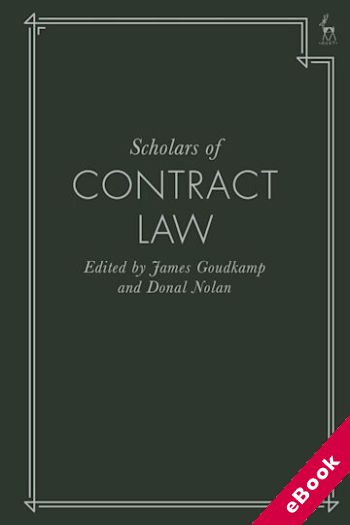
This book provides a counter-balance to the traditional focus on judicial decisions by exploring the contribution of legal scholars to the development of private law.
In the book the work of a selection of leading scholars of contract law from across the common law world, ranging from Sir Jeffrey Gilbert (1674–1726) to Professor Brian Coote (1929–2019), is addressed by legal historians and current scholars in the field. The focus is on the nature of the work produced by the scholars in question, important influences on their work, and the impact which that work in turn had on thinking about contract law. The book also includes an introductory chapter and an afterword by Professor William Twining that explore connections between the scholars and recurrent themes.
The process of subjecting contract law scholarship to sustained analysis provides new insights into the intellectual development of contract law and reveals the central role played by scholars in that process. And by focusing attention on the work of influential contract scholars, the book serves to emphasise the importance of legal scholarship to the development of the common law more generally.