
The eBooks we sell are sold as a single-user licence and are intended for the end user only.
The sale of some eBooks are restricted to certain countries. To alert you to such restrictions, please select the country of the billing address of your credit or debit card you wish to use for payment.
For further information see https://www.wildy.com/ebook-formats
Once the order is confirmed an e-mail will be sent to you to allow you to download the eBook. For UK purchases this will be automatic. For purchases outside the UK a member of staff will need to confirm the sale. (Staff are available to do this during normal business hours, Mon-Fri 8:30-17:00 UK time)
All eBooks are supplied firm sale and cannot be returned. If you believe there is a fault with your eBook then contact us on ebooks@wildy.com and we will help in resolving the issue. This does not affect your statutory rights.
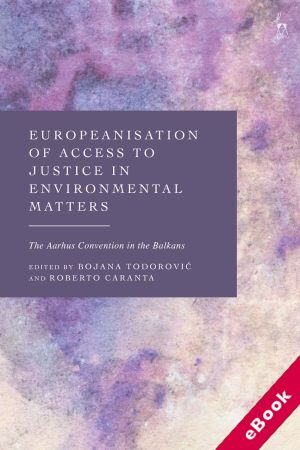
This book analyses the ways in which Article 9 of the Aarhus Convention enables environmental access to justice in the Balkans, a region at the epicentre of extreme climate change events.
Adopting a law-in-context approach, the chapters explore national cultures and driving forces shaping the implementation of Aarhus standards in Albania, Croatia, North Macedonia, Romania, Slovenia, and Serbia, paving the way for their comparative assessment.
The book combines EU law and the case law of the European Court of Human Rights with the bottom-up Europeanisation brought about by rising environmental protests and the activism of civil society organisations in the region. In doing so, it explores the extent to which these Balkan countries comply with requirements stemming from Article 9 of the Aarhus Convention, and whether, despite national differences, it is possible to talk about Europeanisation of access to justice in environmental matters.
The interdisciplinary approach and geographical scope of the book make it an important read for academics and practitioners, as well as for the civil society sector and policy makers grappling with the normative and practical challenges around environmental access to justice – both in and beyond Europe.










