
Wildy Logo
(020) 7242 5778
enquiries@wildy.com

Book of the Month

Cover of McMeel on the Construction of Contracts: Interpretation, Implication and Rectification

McMeel on the Construction of Contracts: Interpretation, Implication and Rectification

Price: £225.00

Land Registration Manual
4th ed


 Ash Jones


Welcome to Wildys

Watch


Judicial Cooperation in Commercial Litigation 3rd ed (The British Cross-Border Financial Centre World)


 Ian Kawaley, David Doyle, Shade Subair Williams


Offers for Newly Called Barristers & Students

Special Discounts for Newly Called & Students

Read More ...


Secondhand & Out of Print

Browse Secondhand Online

Read More...


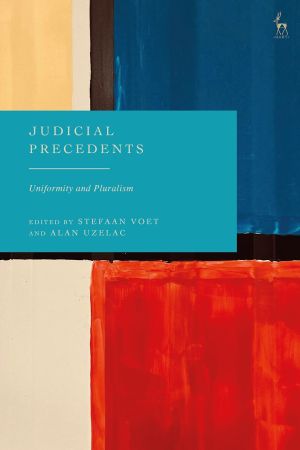
Judicial Precedents: Uniformity and Pluralism

Edited by: Stefaan Voet, Alan Uzelac

ISBN13: 9781509991198
To be Published: June 2026
Publisher: Hart Publishing
Country of Publication: UK
Format: Hardback
Price: £100.00


This book considers what kind of binding force judicial decisions (should) hold in modern societies.

It focuses on the two most prominent legal traditions, common law and civil law. It explores the developing trend in civil law countries to expand the influence of judicial precedents, discusses the fundamental issues which arise from this trend, and looks at recent developments in common law countries.

Through this prism, the book looks at the implications of the doctrine of judicial precedents and how it is construed in jurisdictions that recognise it. It investigates the impact of newly recognised legislative or quasi-legislative powers vested in high courts on the doctrine of separation of powers. It considers whether courts in common law and civil law systems share a uniform understanding of precedents.

The book goes on to consider whether these developments are beneficial when it comes to addressing existing challenges or whether they lead to a host of new problems, potentially exacerbating the crisis of judicial legitimacy.

In relation to the hierarchical nature of civil law justice systems, it asks whether binding rulings from higher courts pose a potential threat to substantive judicial independence, limiting the open and pluralistic dialogue between lower and higher courts. It then goes on to reflect whether binding opinions from the highest judicial instances encroach upon the prerogatives of legislative bodies, resulting in the creation of suboptimal laws.


Subjects:
Jurisprudence
Contents:
1. Introduction
Stefaan Voet (KU Leuven, Belgium) and Alan Uzelac is (University of Zagreb, Croatia)
2. Potential Perils of Precedent: Reflections on the American Experience
Richard L Marcus (UC Law San Francisco, USA)
3. The Evolution of Precedent in England and Wales in the Light of Digitisation
John Sorabji (University College London, UK)
4. Deciding Once and for All? Past and Present Debates on Procedural Mechanisms of the Supreme Courts in Austria and Germany to Decide More Than the Cases Before Them
Julius Schumann (University of Vienna, Austria)
5. Lights and Shadows of the Polish Supreme Court's Instruments to Ensure Uniformity in Civil Case Law
Piotr Rylski (University of Warsaw, Poland)
6. Introducing the Limited Precedent System in Hungarian Procedural Law
Viktória Harsági (Pázmány Péter Catholic University, Hungary)
7. The “Italian Style” Precedent
Francesca Ferrari (Università degli Studi dell'Insubria, Italy)
8. Rules that Enhance the “Rule” of Persuasive Precedent
João Marques Martins (University of Lisbon, Portugal)
9. Precedential Effects of Judicial Decisions under Slovak Law on Civil Litigation. The Road to Uniformity or Deformity?
Marek Ivanco (Judicial Academy of the Slovak Republic, Slovakia)
10. Methods for Securing the Uniformity of the Law?
Tatjana Zoroska Kamilovska (Methodius University in Skopje, North Macedonia)
11. Between Tradition and European Integration: Methods for Ensuring the Uniform Application of Law in the Republic of Serbia
Branka Babovic Vuksanovic (University of Belgrade, Serbia)
12. “But Do Material Facts Match?” The Problem of Mechanical Application of Precedents in Europe
Aleš Galic (University of Ljubljana, Slovenia)
13. The Dutch Preliminary Rulings Technique as a Model for Contentious and Non-Contentious Procedures
Stefaan Voet (KU Leuven, Belgium)
14. Building Uniformity through Case Management. The Case of the Chileans High Courts
Ramón García Odgers (Universidad Católica de la Santisima Concepción, Chile)
15. The Rationality of Binding Precedents in Brazilian Civil Procedure: From Samba to Stare Decisis a New Paradigm
Hermes Zaneti Jr. (Federal University of Espírito Santo, Brazil)
16. Does the Preliminary Rulings Procedure Ensure Uniformity of Case-Law in EU Member States?
Jorg Sladic (KU Leuven, Belgium)
17. The 'Systemic' Effects of the 'Non-binding' Opinions Rendered by the European Court of Human Rights under Protocol N.
16
Albert Henke (Università degli Studi di Milano, Italy)









